مركز سوث24 للأخبار والدراسات
مركز سوث24 للأخبار والدراسات


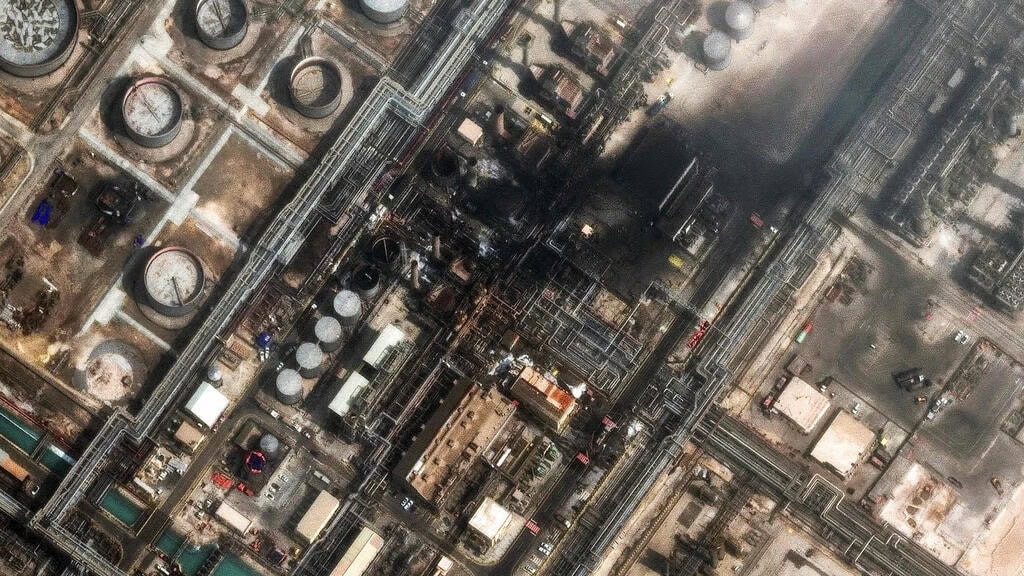
Satellite imagery showing the aftermath of Iranian attack on Aramco refinery (Photo: AFP PHOTO / SATELLITE IMAGE ©2026 Vantor)
آخر تحديث في: 03-03-2026 الساعة 9 مساءً بتوقيت عدن
Three scenarios loom in the Third Gulf War: a weakened but intact Islamic Republic, a US-engineered Venezuelan scenario, or full-scale “Balkanization” along identity lines.
Dr. Andrew Korybko (South24 Center)
Another Gulf War has broken out, which is either the second if one counts Operation Desert Storm as the first or the third if one considers the Iran-Iraq War of the 1980s as the first. This time Iran and its “Resistance Axis” allies are pitted against the US and Israel. Iran has also carried out missile and drone strikes against the Gulf Kingdoms on the pretext that the US military infrastructure on their territories is being used in the US’ attacks on Iran. The Gulf Kingdoms have of course denied Iran’s allegations.
The latest Gulf War hasn’t even been raging for a week, but it’s still possible to forecast the post-war balance of power, albeit depending upon which terms the war ends. Three scenarios are the most likely: 1) the Islamic Republic survives with its territorial integrity intact but is greatly weakened; 2) the US replicates the Venezuelan scenario of a US-friendly government coming to power; and 3) “Balkanization” along identity lines begins to tear the country apart regardless of its governing system by that time.
The first scenario is plausible, but only if Iran agrees to far-reaching concessions on its nuclear and missile programs along with cutting off its regional allies like Hezbollah and the Houthis, which Tehran hitherto considered unacceptable. The reason behind its resistance is that policymakers consider such concessions to amount to Iran’s de facto strategic surrender to the US and Israel. They also believe that more attacks, and possibly another round of war, would be inevitable after Iran basically disarms itself.
It’s possible, however, that this scenario materializes in the event that Iran begins to inflict more damage to Israeli and US interests. That could possibly prompt them to declare victory on the grounds that Iran’s military forces, including its missile program, have been greatly degraded by the conflict. This might also happen if they run low on missile interceptors, don’t knock out enough of Iran’s by then, and the Islamic Republic either inflicts such damage on them to this end or threatens to do so if hostilities don’t cease.
The second scenario is unlikely but it’s nonetheless what Trump declared that he’s aiming for when he recently said that “What we did in Venezuela, I think, is the perfect, the perfect scenario.” It’s very difficult to implement in Iran because of the IRGC’s power over the government, society, and the economy. Their Iran’s most elite forces, considered to be “a state within a state” by this point, and are highly committed to their interconnected anti-American and anti-Israeli/-Zionist ideologies.
While Venezuela’s Interior Ministry plays a somewhat comparable role to the IRGC, and the local militias that it controls were also thought to be committed to their anti-American and Bolivarian ideologies, they ultimately weren’t willing to die for them. That’s why they, from their chief on down, complied with the US’ demands after President Nicolas Maduro’s capture. Unlike them, no single person wields ministerial-level power over the IRGC, and they’re much more ideological. This makes the scenario much less likely.
The third scenario could metastasize the war into a series of protracted local conflict either running in parallel to the latest Gulf War or following its end. It also can’t be ruled out. Some minority-majority regions like the Kurdish-inhabited west are already known to be hotbeds of anti-government activity. This doesn’t mean that all of their co-ethnics are against the Islamic Republic or want to separate from Iran even if they are, just that foreign forces could capitalize on this to weaken the country at this time.
Any significant Kurdish uprising could prompt a Turkish military intervention on the same pretexts as its previous ones in neighboring Iraq and nearby Syria, while a significant Azeri uprising in the north could prompt the same by Azerbaijan, which is NATO-member Turkiye’s military ally. Bloomberg reported earlier in the year that Turkiye was also considering joining the Saudi-Pakistani, but even if this doesn’t soon happen, all three and Azerbaijan could coordinate military campaigns inside a “Balkanizing” Iran.
The late Iraqi leader Sadaam Hussein supported Arab separatists in Iran’s Khuzestan Province, the role of which could be played by Saudi Arabia in this scenario, while Pakistan could intervene in the province of Sistan and Balochistan on the pretext of fighting cross-border Baloch separatists. “Balkanization”, with or without direct military intervention by Iran’s neighbors, would weaken Iran and thus make it a much less powerful possible post-war ally for the US and Israel, which might not favor this scenario for that reason.
Having touched upon the three most likely scenarios of how the latest Gulf War could end, it should be mentioned that its worsening is also possible before then if Iran continues its attacks against the Gulf Kingdoms and provokes one, some, or all of them into joining the war against it. The Gulf Kingdoms’ interests are for the war to end as soon as possible due to their economic fragility and the ease with which Iranian attacks could destabilize them, but continued attacks might force them to intervene.
Moreover, any major damage to Israel and/or the US such as striking the Dimona nuclear reactor or sinking a ship (especially an aircraft carrier) could lead to them nuking Iran, which could result in a regional ecological disaster. Neither has intimated any such intention, and such a move would widely be interpreted by the international community as being done in panic and possibly desperation (not that their leaders seem to care), but it most certainly cannot be discounted.
Everything shared till this point enables observers to obtain a better vision of the region’s future after the latest Gulf War ends. If the first scenario of the Islamic Republic surviving with its territory intact occurs, regardless of the Gulf Kingdoms joining the war and/or Iran being nuked, then Iran will be totally isolated from the region and contained within it. Its economic situation would likely further deteriorate, more unrest is likely, and the consequent cycle of violence could make instability a defining feature.
In this scenario, the Gulf Kingdoms, with the possible exception of the UAE that’s at loggerheads with Saudi Arabia right now, might consolidate their military forces under the Gulf Cooperation Council (GCC), thus placing their regional integration group on the path to becoming an “Arab NATO” with time. If the UAE doesn’t subordinate itself to Saudi Arabia, then it would likely strengthen ties with Israel, which might lead to Saudi Arabia directing its allies to isolate the UAE like they all once tried to isolate Qatar.
Regardless of whatever the future of Emirati-Saudi ties holds, the first scenario would see several power centers in West Asia: the Saudi-centric GCC (with or without the UAE); Israel (with or without strengthened ties with the UAE); Turkiye; and a much more weakened Iran whose “Resistance Axis” members would likely be very weakened as well. The US could then multi-align between, or cynically “divide-and-rule”, these power centers to more or less ensure that the region remains within its orbit.
The second scenario of the US replicating the Venezuelan sequence in Iran by facilitating the rise of a pro-American government there might inadvertently lead to civil war due to how unlikely it’s assessed to be that the highly ideological and very well trained IRGC would accept anything of the sort. If enough groups or “factions” therein side with a new pro-American government, if divisions even exist which can’t be known with certainty, then maybe they’d be able to destroy the remaining holdouts with time.
In the best-case scenario from the US’ perspective, there’d be a relatively smooth political transition of an indeterminate length of time which restores Iran’s pre-revolutionary role as an American and Israeli ally, thus becoming a strong regional power center for balancing the Arab and Turkish ones. Iran might also aid the Turks in challenging Russia in the South Caucasus and Central Asia. The worst-case scenario is that Iran “Balkanizes”, with the IRGC as a whole or some groups therein functioning as warlords.
This leads directly to that third scenario and could be one of the triggers for it, which might happen without ethnic minorities rising up in the peripheral regions (with or without conventional foreign military support) or in parallel to it, and regardless of whatever Iran’s governing system is by that time. If “Balkanization” trends are severe enough, then at least one neighboring conventional military intervention is likely, but what might unfold next is highly uncertain.
What Baku considers to be “South Azerbaijan” could be annexed or “reunited” with Azerbaijan, while Pakistan and/or Turkiye could retain military presences in the Baloch and Kurdish areas on anti-terrorist pretexts under the guise of peacekeepers, even if only unilaterally without UNSC approval. “No-fly zones” like those over Iraq after Operation Desert Storm till 2003 could also enter into place, with or without UNSC approval, if the “Balkanized” regions aren’t annexed or become stand-alone statelets.
All in all, Iran’s future doesn’t look bright, and its new leadership that replaced the one which was just assassinated by the US and Israel might personally regret that their country’s ally Yahya Sinwar orchestrated the October 7th terrorist attack that set into motion this disastrous chain of events. Iran and its “Resistance Axis” are weaker than ever before, both are now facing existential crises, and Israel is on the path to regional superpower status. Present-day reality is now an ever-worsening nightmare for Iran.


قبل شهرين
قبل 3 أشهر