مركز سوث24 للأخبار والدراسات
مركز سوث24 للأخبار والدراسات


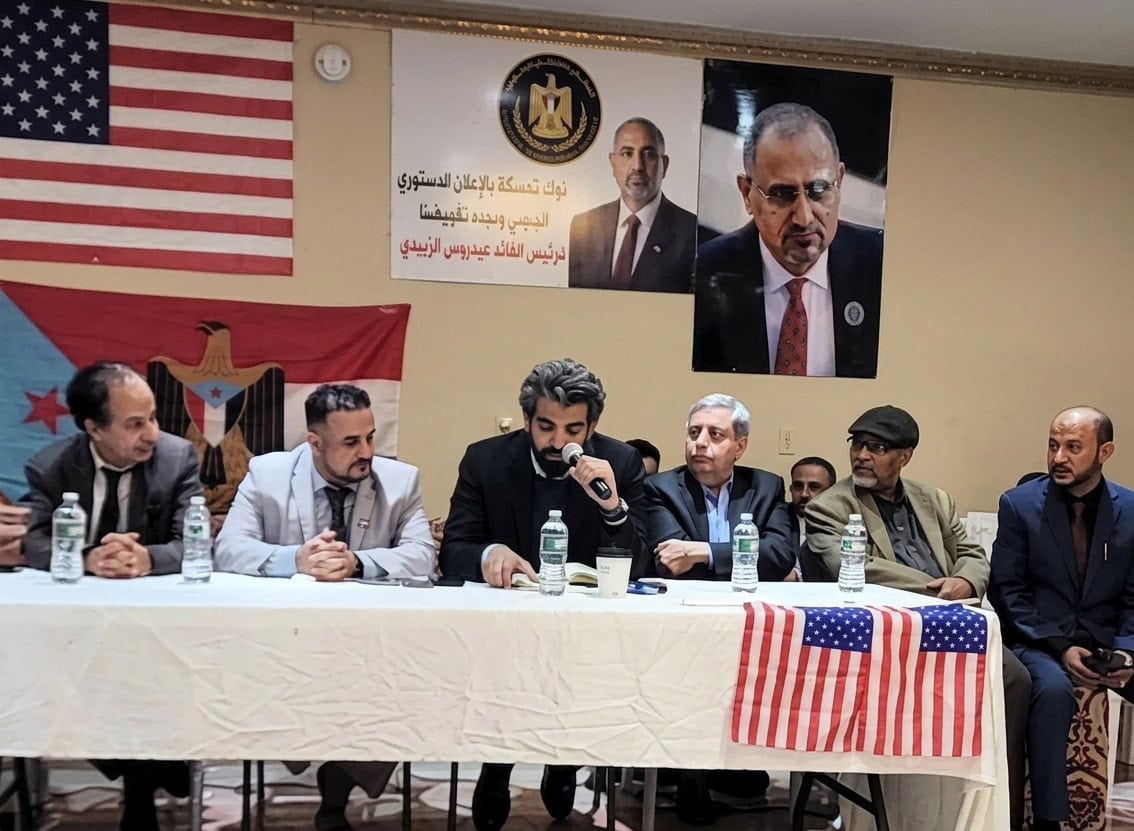
A meeting of the Southern community in New York attended by STC official Amr Al-Bidh, April 19, 2026 (Activists).
آخر تحديث في: 20-04-2026 الساعة 7 مساءً بتوقيت عدن
Aden (South24 Center)
The Southern community in New York held a meeting on Monday (April 19), chaired by Amr Al-Bidh, the Representative of the Southern Transitional Council (STC) President for Foreign Affairs. The meeting focused on discussing the latest political and security developments in South Yemen and on enhancing the role of Southern communities abroad in supporting the Southern cause.
The meeting featured prominent participation by the President of the Southern Transitional Council (STC), Major General Aidarous Al-Zubaidi, via telephone. Al-Zubaidi delivered key political messages amid the exceptional circumstances currently facing the South.
Al-Zubaidi reaffirmed the Council’s commitment to the struggle to achieve the aspirations of the people of the South, noting that the Southern national project is rooted in a long history of struggle and sacrifice. He emphasized that this path is “irreversible.”
Al-Zubaidi called on the people of the South, both at home and abroad, to participate widely in commemorating the ninth anniversary of the STC’s founding on May 4. He said the occasion represents a political milestone reflecting the “resilience of the people of the South and their ongoing journey toward freedom and independence.”
He noted that events will be held across various Southern governorates and urged Southern communities abroad to contribute effectively to their success and to strengthen the presence of the Southern cause internationally.
Al-Zubaidi praised the role of these communities as a key partner in the national movement, commending their steadfast support for the STC and the cause of the people of the South.
In the same context, Amr Al-Bidh provided an extensive briefing on the political landscape, asserting that the STC remains the most prominent political force on the ground despite attempts to weaken it or exclude it from the political process.
Al-Bidh said that events since last January are linked to a conflict over political arrangements that the STC has strongly opposed, as they—according to him—aim to reshape the balance of power at the expense of the South.
He added that the targeting of Southern forces during those events led to a decline in their field capabilities, which negatively affected the security situation and contributed to rising Houthi threats and the expansion of extremist activities.
Al-Bidh stressed that the STC rejects any political settlement that does not guarantee fair representation for the Southern cause, emphasizing that any dialogue must be based on the will of the people of the South as the “true reference” for any political outcomes.
He also addressed the controversy surrounding attempts to create an alternative Southern political scene, noting that the absence of a unifying political framework reflecting the will of the Southern street poses real challenges to any negotiation path.
Furthermore, he called for avoiding internal disputes and focusing on strategic goals, warning that fragmentation within the Southern ranks serves parties seeking to undermine its political presence.
Al-Bidh concluded by emphasizing the importance of the role of Southern communities abroad, calling for a shift from media engagement to building tangible influence within decision-making circles in host countries.
He stressed the need for these communities to integrate into their host societies to defend the Southern cause more effectively, while continuing to support the domestic front amid economic and humanitarian challenges. He affirmed that the current phase requires political and organizational cohesion, as well as maintaining the popular base supporting the STC as the fundamental pillar for any future movement.
The Southern Transitional Council (STC) was established on May 4, 2017, following the Aden Declaration, which authorized the formation of a Southern political body to represent the aspirations of the people of the South. On May 11, 2017, the STC officially announced its leadership structure, including the formation of its Presidency, headed by Aidarous Al-Zubaidi. Since then, the Council has emerged as a key political and military actor in South Yemen, advocating for the restoration of the Southern state and seeking representation in regional and international political processes.


قبل شهرين

قبل 1 شهر
قبل شهرين