SOUTH24 CENTER FOR NEWS & STUDIES
SOUTH24 CENTER FOR NEWS & STUDIES


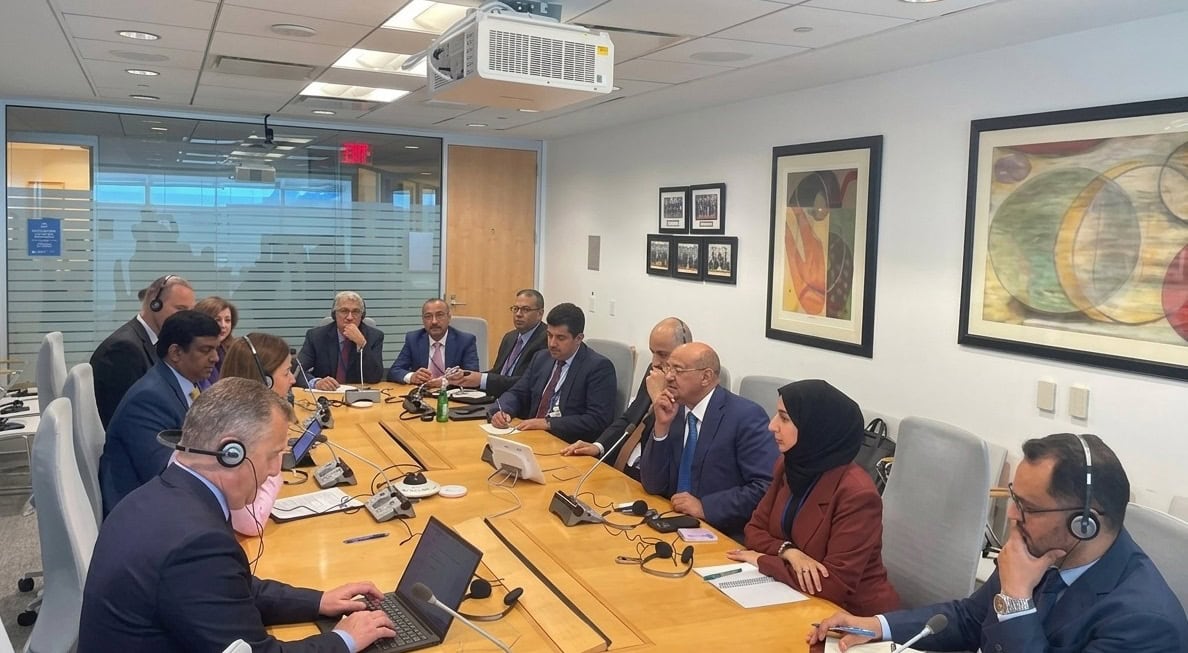
CBY Governor Ahmed Ghaleb and Yemeni officials during a meeting with the IMF mission on the sidelines of the Spring Meetings in Washington, D.C., April 15, 2026 (Central Bank of Yemen).
Last updated on: 16-04-2026 at 6 PM Aden Time
Aden (South24 Center)
The Yemeni government on Wednesday (April 15) discussed next steps after resuming Article IV consultations with the International Monetary Fund (IMF), as the country faces mounting economic pressures driven by ongoing conflict and regional instability.
The discussions took place during a joint meeting between the Governor of the Central Bank of Yemen (CBY), Ahmed Ghaleb, senior government officials and ministers, and the IMF Mission Chief for Yemen, Esther Perez, on the sidelines of the 2026 Spring Meetings of the World Bank Group and the IMF in Washington, D.C.
According to a CBY statement, the meeting focused on follow-up steps to advance the consultations, including establishing the technical and institutional conditions required to enter a Staff-Monitored Program (SMP)—a step often seen as a precursor to broader financial support and reform programs. The SMP aims to address imbalances in fiscal and monetary policies within a comprehensive reform framework that would pave the way for accessing international financing tools and supporting economic recovery.
The meeting also reviewed the impact of developments in the Middle East on the Yemeni economy, particularly rising shipping and insurance costs, as well as increases in energy and essential commodity prices. These factors have intensified pressure on public finances and made it more difficult to meet the population’s basic needs.
Yemeni officials discussed with the IMF mission the measures and policies the government intends to adopt to mitigate these challenges, while balancing economic stability requirements with humanitarian needs.
The IMF announced on April 3 that its Executive Board had approved the results of the 2025 Article IV consultations with Yemen, following a hiatus of approximately 11 years. Article IV consultations are the IMF’s regular economic reviews of member states, assessing fiscal and monetary policies and providing recommendations that can guide reform and unlock future financial support.
Under this process, an IMF staff team visits the member country, collects economic and financial data, and holds discussions with officials on economic developments and policies. The team then prepares a report that forms the basis for the Executive Board’s deliberations.
Since late March, the Central Bank of Yemen has held a series of engagements with international partners, including the Executive Director representing the Arab Group and the Maldives at the Fund, the World Bank Vice President, as well as the Ambassador of the Kingdom of the Netherlands and the UN Envoy to Yemen.
These efforts also included internal steps to strengthen the institutional framework, such as the first session of the Board of Directors of the Institute of Banking Studies following its reconstitution, activating the role of the Deposit Insurance Corporation from Aden, and convening the National Committee for Regulating and Financing Imports.
The moves come as part of broader government efforts to enhance coordination with international partners and advance economic reform, amid mounting challenges facing the Yemeni economy due to ongoing conflict and declining resources.