SOUTH24 CENTER FOR NEWS & STUDIES
SOUTH24 CENTER FOR NEWS & STUDIES


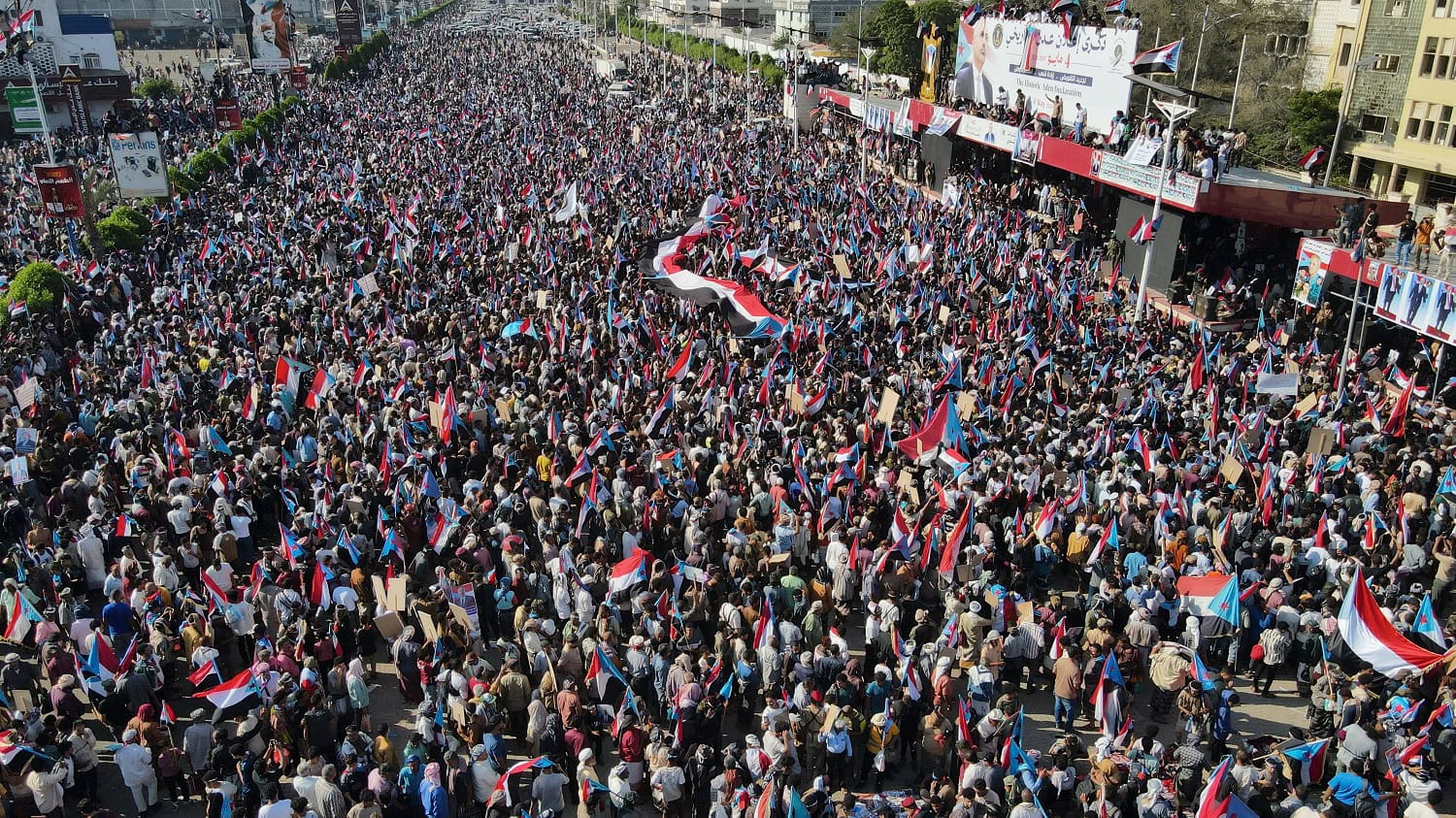
Mass Rally in Aden on the Anniversary of the Southern Transitional Council’s Founding (May 4), in Support of Aidarous Al-Zubaidi, May 4, 2026 (South24 Center)
Last updated on: 04-05-2026 at 9 PM Aden Time

Aden (South24 Center)
Tens of thousands of southern Yemenis rallied in the capital, Aden, on Monday (May 4), gathering at Al-Oroudh Square in Khormaksar district to mark the ninth anniversary of the historic “Aden Declaration,” which paved the way for the establishment of the Southern Transitional Council (STC) in May 2017.
Crowds filled the square from the early hours of the morning, in one of the largest public gatherings witnessed in Aden in recent months. Participants extended beyond the square’s perimeter, with a continuous influx of attendees even after the event had officially begun.
Convoys of supporters arrived from several southern governorates, including Al-Dhalea, Abyan, Lahj, and Shabwa, having set out on Sunday (May 3) via major routes leading into Aden.
Participants raised the flag of South Yemen and chanted slogans expressing support for the STC and its President, Aidarous Al-Zubaidi.
The rally came a day after a recorded address by Al-Zubaidi, in which he stressed adherence to what he described as “popular legitimacy,” stating that the anniversary represents an opportunity to renew commitment to the southern public.
The speech was broadcast via an audio recording aired by Aden Independent Channel (AIC) on Sunday (May 3) and lasted around ten minutes. No official clarification was provided regarding the location of the recording, amid conflicting reports over Al-Zubaidi’s whereabouts. While STC sources indicated he is inside the country, estimates linked to Saudi Arabia suggested he may be abroad, including unconfirmed claims placing him in the United Arab Emirates.
Al-Zubaidi affirmed that the council “remains committed to the option of peaceful and conscious resistance” to what he described as illegitimate measures since last January, adding that the current phase requires “the highest levels of national awareness to preserve gains.” He warned of “attempts to reshape the political landscape in the South and strip it of genuine national representation,” as well as efforts to “drag it into insincere dialogues leading to political fragmentation.”
He further stressed that “true legitimacy is popular legitimacy, and the people of the South are its sole source,” noting that the council will continue to adhere to a political path based on dialogue in line with the January 2 declaration and the National Charter.
On the security and military levels, he stated that southern forces and security agencies represent the “backbone of the national project,” describing them as a “red line,” and emphasized that building a southern army is a “national and strategic necessity,” not a temporary option.
He also highlighted the role these forces have played in combating terrorist groups and securing international maritime routes, noting that their readiness constitutes a pillar of stability in the South.
Al-Zubaidi called on international actors involved in the Yemeni file to “seriously listen to the voice of the southern people,” warning that ignoring the issue could further complicate the political landscape and affect regional stability.
The speech comes months after notable political developments, most prominently the announcement of the dissolution of the STC on January 9 from Riyadh, following the departure of a high-level delegation on January 7 for consultations with Saudi Arabia, which sparked widespread debate over surrounding political pressures.
In a statement issued during Monday’s event, the STC reaffirmed that restoring an independent and fully sovereign southern state within its pre-May 21, 1990, borders remain a fixed strategic objective that is non-negotiable and cannot be delayed. It stressed that the South represents a unified political, geographical, historical, and legal entity that does not accept fragmentation or division.
The statement added that the STC cannot be bypassed in any political process, as it represents the national and political framework encompassing the southern cause. It emphasized that any settlement that does not recognize the South as a principal party and guarantee its full participation is unacceptable.
It also linked the political solution to the provisions of the political declaration and constitutional announcement issued on January 2, 2026, describing them as a roadmap for resolving the crisis between the North and the South away from externally imposed solutions.
The statement reiterated that the southern armed forces represent a “red line,” stressing that preserving their unity, cohesion, national doctrine, and leadership reference is a sovereign matter that cannot be compromised.
It further called for independent investigations into what it described as violations in southern governorates since early 2026, including arrest warrants and the closure of offices, urging accountability for those responsible.
Notably, the Southern Transitional Council emphasized this time that it is a transitional council for the state of South Arabia, in a move that appears aimed at consolidating an identity framework for its political project toward an independent southern state bearing the same designation.
Days before the rally, several STC members, speaking from what they described as their enforced residence in Riyadh, expressed support for Al-Zubaidi, underscoring the significance of the May 4 anniversary as a political symbol reflecting the continuity of the southern project.
Yahya Ghaleb Al-Shuaibi, a member of the STC Presidency, described May 4 as “a great day and the beginning of a historic phase in the trajectory of the southern cause.”
Senior leadership member Abdulnasser Al-Wali said the anniversary represents a moment of popular mandate and a peaceful expression of southern aspirations, while STC official Nizar Haitham stressed adherence to what he described as principles of “dignity and steadfastness,” rejecting any attempts at compromise.
This year’s commemoration carries significance beyond its ceremonial nature, as it comes amid efforts to reaffirm the STC’s popular presence and renew its leadership mandate, against the backdrop of a Saudi-backed process aimed at dismantling the council.
The date marks a pivotal moment in the southern cause. On May 4, 2017, Aden witnessed mass protests that resulted in granting Al-Zubaidi a mandate to form a political entity, later formalized with the announcement of the STC on May 11 of the same year.
Commemorative events are also continuing in other governorates, with major cities in Hadramout, including Mukalla and Seiyun, preparing to host similar public gatherings in the coming days.