SOUTH24 CENTER FOR NEWS & STUDIES
SOUTH24 CENTER FOR NEWS & STUDIES


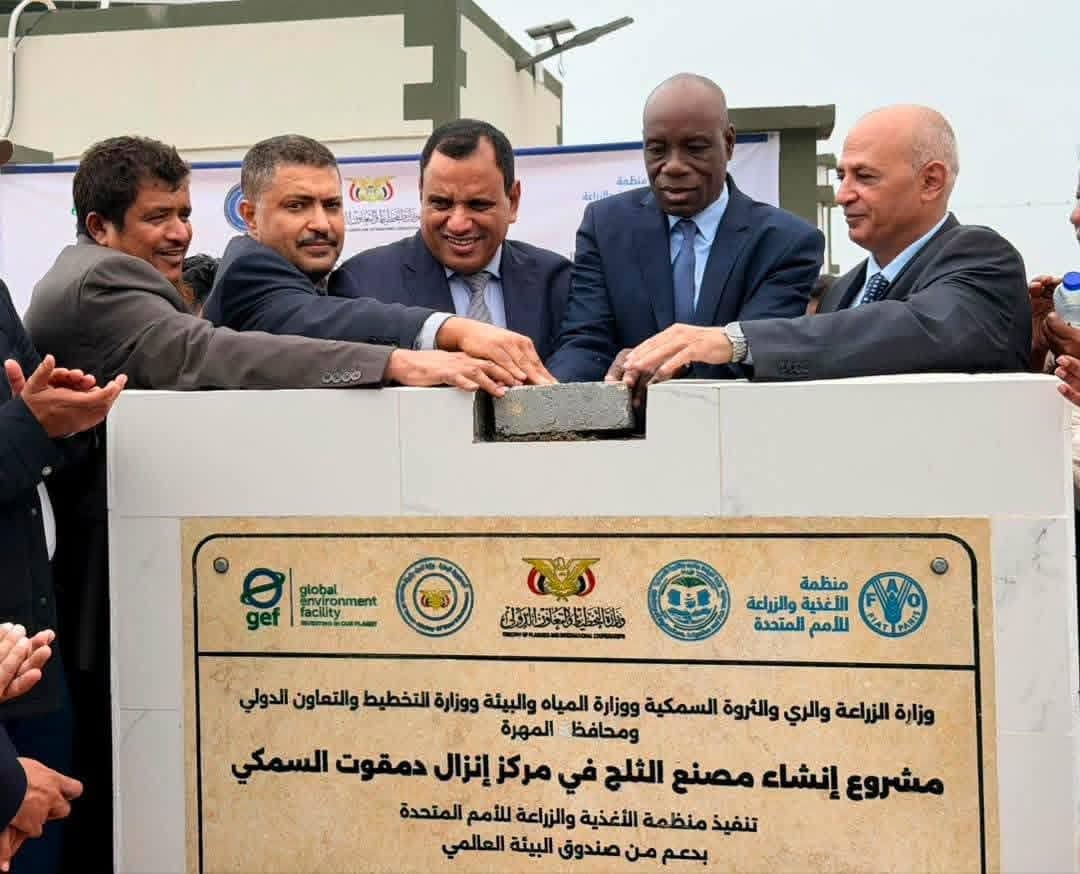
Yemeni officials and representatives of the Food and Agriculture Organization lay the foundation stone for an ice factory at the Damqout Fish Landing Center in Al Mahra Governorate, Yemen, August 2, 2026. (Saba News Agency)
19-10-2026 at 6 PM Aden Time

Zaher Zein (South24 Center)
Yemen has accumulated plans and pledges to address climate change, beginning with the National Adaptation Program of Action in 2009, followed by its climate contribution submitted in 2015, and culminating in the “vision” for its third Nationally Determined Contribution (NDC), submitted to the United Nations climate convention in 2025. However, despite signing the Paris Agreement in 2016, Yemen has yet to ratify it, while the vision document outlines a path toward completing and submitting its NDC. [1–4]
These efforts face an additional challenge from the war, which has weakened state resources and the institutions responsible for water management and climate risk preparedness. Revenues of the internationally recognized government fell by about half following the suspension of oil exports in late 2022, while government spending declined from 27.7% of GDP in 2022 to 22.3% in 2024. These figures do not directly measure climate spending, but they illustrate the constrained fiscal environment in which the government operates. Meanwhile, the World Bank has warned of the overlapping effects of conflict and risks related to water scarcity, agriculture, and disasters. [5, 6]
This report examines how the Yemeni government has addressed its climate commitments and whether it has translated them into policies, coordination mechanisms, and investments that can be implemented. It traces projects from announced funding to field activities and outcomes, drawing on official documents, funding agency records, statements from officials and experts, and local sources. It also distinguishes between approved, transferred, and spent funding, as well as between the inauguration of a facility, its continued operation, and the achievement of verifiable impact.
Climate Commitments: From Pledges to Funding
Yemen’s climate policies predate the war. The country joined the United Nations Framework Convention on Climate Change (UNFCCC) in 1996, the Kyoto Protocol in 2004, and the conventions on biodiversity and combating desertification. In 2009, it developed a National Adaptation Program of Action, identifying priorities such as early warning systems, rainwater harvesting, coastal protection, and strengthening the resilience of agriculture and fisheries to climate risks. However, including these priorities in a plan does not prove that the corresponding projects were implemented. [1, 7–10]
In its first climate contribution in 2015, Yemen proposed reducing emissions by 14% below business-as-usual levels by 2030: 1% unconditionally and 13% subject to receiving international funding, technology transfer, and capacity building. In other words, most of its ambition depended on external support. The following year, Yemen signed the Paris Agreement but had not ratified it as of October 2026. This is an important legal distinction when describing the status of its commitments under the agreement. [2, 3]
This complexity resurfaced with the document titled “Vision for the Third Nationally Determined Contribution,” which Yemen submitted to the UNFCCC in November 2025. The convention’s registry lists it as NDC 3.0 and includes it among active entries, while also clarifying that Yemen is not a Party to the Paris Agreement and that its contribution is available in the archive. In a response to South24 Center, Joseph Peter Ndemo, an associate program officer in the Transparency Division of the UNFCCC secretariat, said the document does not qualify as an active contribution under the Paris Agreement because Yemen has not ratified it. He added that it was the latest file the registry had received from the country. [4, 5]
Dr. Abdulraqib Al-Akishi, technical director of the Climate Change Unit at the Ministry of Water and Environment, described the document in a statement to South24 Center as an initial “vision” preceding the full version. He said the completed submission is expected at the COP31 climate conference. The vision aims to increase the share of renewable energy to 35% by 2035. However, it also stipulates that sectoral consultations must be completed, benefits analyzed, and an investment framework prepared before the finalized contribution is submitted. The document therefore sets a direction and proposes targets but does not establish that these targets have been translated into a funded implementation plan. [4]
National reports reveal another gap between reporting and implementation progress. Following Yemen’s submission of its Third National Communication in 2018, Al-Akishi said the Fourth National Communication remained under preparation. Initial sectoral drafts had been completed and reviewed, while the Climate Change Unit was awaiting pre-final versions to compile and publish the document. The third communication noted that Yemen lacked an integrated framework for measuring, reporting, and verifying emissions reductions, as well as institutional arrangements for updating its greenhouse gas inventory and preparing periodic reports. [11]
In his statement, Al-Akishi said the National Adaptation Plan had reached the stage of contracting experts, while initial steps toward the Low-Emission Development Strategy and the measurement, reporting, and verification (MRV) system had been limited to sectoral meetings, work plans, and contractual arrangements. He also said the Higher Committee for Climate Change had “not undertaken any actual activity” and may have held only one meeting, to his knowledge, although he had no documents confirming this. By contrast, the United Nations Development Program (UNDP) website states that the National Climate Committee was updated in 2023 to coordinate implementation of the adaptation plan. The distinction lies between formally updating the committee and having evidence of regular meetings, decisions, and implementation follow-up. [12]
Professor Dr. Salem Rabie Saeed Bazar, a lecturer at the Faculty of Environmental Sciences and Marine Biology at Hadramout University, links the effectiveness of internationally funded projects to the extent to which Yemeni institutions and local communities have ownership over decision-making. He told South24 Center that the government should lead strategic decisions and that activities should be designed in line with national plans and local needs, with authorities and communities involved from the outset and Yemeni personnel’s capacities strengthened. He added that project sustainability requires integration into national institutions and mechanisms to ensure continued funding after external support ends, emphasizing that “an international organization or institution is a technical partner, not a guardian.”
Announced funding for these policies must be assessed according to their purpose and disbursement stage. The Green Climate Fund records approximately $5.9 million in readiness approvals for Yemen. These allocations support planning, capacity building, data, and project preparation; they are not necessarily funding for the construction of physical facilities. One example is a $2.67 million grant for the National Adaptation Plan, covering a project period from April 2025 to July 2029. The UNDP project page lists total contributions of $986,691 and records deliveries of $16,413 in 2025 and $80,916 in 2026. These figures appear under separate financial categories on the project page and do not, on their own, provide a detailed breakdown of expenditure by activity or the amounts reaching beneficiaries. [12, 13]
The same distinction applies to the Low-Emission Development Strategy and MRV system project, which runs from May 2024 to June 2027. The UNDP website lists total contributions of $871,534, alongside reported deliveries of $38,600 in 2025 and $8,889 in 2026. Its listed achievements include the start of efforts to align the strategy with the updated NDC and Yemen’s program with the Green Climate Fund. These figures do not mean that the strategy or monitoring system has been completed or is operational. [14]
In a statement to South24 Center, Dr. Ray Salvatori Jennings, a researcher affiliated with the University of Maine’s Climate Change Institute and a senior World Bank adviser on fragility and conflict, urged a distinction between four stages: funding approval, disbursement, expenditure, and the delivery of tangible benefits. This means that assessing climate commitments does not end with the approval of a plan or grant. It requires tracking the capacities and institutions established, the amounts spent on activities, and the changes experienced by local populations. [15]
Projects in Hawf, Damqout, and the Tuban Delta
The gap between announced funding and field results is clearly evident in two projects: the Tuban Delta project in Lahj Governorate and the Resilient Rural Livelihoods project in Hawf and Damqout in Al Mahra Governorate. In both cases, the questions extend beyond the size of the grants to include how much funding has reached implementing agencies, what has been accomplished, and whether the facilities are operational and providing services to local residents.
In the Tuban Delta, the Adaptation Fund approved a grant of $9,998,560 and records a transfer of $1,188,329 to the United Nations Human Settlements Program (UN-Habitat), equivalent to approximately 11.9% of the grant. In June 2026, the fund approved relocating a planned intervention from the Saber wastewater treatment plant to the Al-Waht plant and revising the results framework and beneficiary estimates. The first plant had completed rehabilitation, while the second was damaged by floods in October 2025. The fund classified the change as minor, stating that it did not alter the project’s overall scope. [16, 17]
Dr. Abdulraqib Al-Akishi, technical director of the Climate Change Unit, said initial assessments had been completed, but construction work had not begun as of October 9, 2026. UN-Habitat referred South24 Center’s inquiries to the Ministry of Water and Environment without providing details on disbursements or progress. The Nahr Organization also documented training for a community assessment team in July, a preparatory step that does not establish that the facilities have been completed. This information indicates what could be verified at the time of reporting but is not sufficient on its own to assess a project running through 2029. [16]
The Resilient Rural Livelihoods project, implemented by the Food and Agriculture Organization of the United Nations (FAO) with funding from the Global Environment Facility (GEF), has a recorded grant of $16,057,798 and announced co-financing of $104,218,400. In August 2026, the opening of fish landing centers in Hawf and Damqout was announced, and the foundation stone was laid for an ice factory in Damqout. The Climate Change Unit subsequently announced the launch of a package of interventions in Hawf, including the two landing sites, the ice factory, a veterinary center, and a reserve administration building, alongside the start of installation work on a monitoring and early warning station. The unit noted that other activities were still underway in Hawf and Socotra. [18–20]
In a statement to South24 Center, a local source familiar with environmental activities in Al Mahra said the two landing centers had been inaugurated, irrigation networks had arrived in Hawf but had not been installed, and the eight greenhouses had not yet arrived. The source also reported that a climate monitoring station had been installed, while the Climate Change Unit’s official announcement described its status as the “start of installation.” The report found no evidence confirming that the landing centers had been operating regularly since their inauguration, nor did it identify the number of users or the allocations for operation and maintenance. An FAO environmental and social document dated April 2026 refers to plans for greenhouses and drip irrigation but does not establish that they have been delivered or become operational. [19, 21]
Environmental expert Tareq Hassan cautions against equating the completion of a facility with successful adaptation. According to his statement to South24 Center, measuring the impact of canals or irrigation networks requires data on the reliability of water delivery and pumping volumes before and after the intervention. He also warns that solar-powered pumping can increase groundwater depletion unless well drilling and water extraction are regulated. [22]
Dr. Khaled Saleh Bawahidi, director of the Center for Environmental and Water Resources Studies at Hadramout University, emphasized in comments to South24 Center the importance of monitoring canal water losses, water distribution records, maintenance, and minutes of water user association meetings. These indicators help establish whether investments have been translated into sustained services rather than merely inauguration facilities.
Dr. Salem Bazar offers a mixed assessment of the capacity of water institutions in Hadramout. According to his statement, the Local Water Corporation in Wadi Hadramout continues to operate a network comprising 49 wells and five well fields, producing approximately 60,000 cubic meters of water daily to serve around 62,000 subscribers despite the crisis. However, he also points to declining oversight since 2015, widespread unregulated well drilling, financial pressures on the corporation, and an increase in water-related disputes. He further warns that using solar-powered pumps without regulating water extraction could exacerbate groundwater depletion.
The latest investment initiative also includes the World Bank’s $153.6 million Water and Irrigation Management Project, which targets the Aden–Tuban basins and Wadi Hajar. It includes rehabilitating irrigation systems, promoting water harvesting, and developing digital systems for managing water and climate resources. These investments offer an opportunity to address existing risks, but the project’s outcomes remain prospective. Their assessment will depend on what is implemented and whether data on disbursements, operation, maintenance, and beneficiaries are available. [23]
In conclusion, a review of Yemen’s climate commitments and projects reveals uneven progress: plans are still being prepared, funding has been approved, some activities have been officially launched, and construction has yet to begin on other projects. War has weakened the resources and institutions needed for implementation. However, assessing these policies ultimately depends on what the relevant authorities can document in terms of coordination, achievements, and follow-up, and to the extent to which plans have been translated into services that protect people and their resources.
The value of grants and photographs of opening ceremonies are not enough to determine whether these efforts have succeeded. This requires the publication of clear data on fund transfers and expenditure, implementation stages, operation and maintenance, and the impact of projects on water resources and livelihoods, as well as evidence of local community participation. Without such data, results remain difficult to verify. This does not establish that funds have been misused or that projects have failed, but it makes accountability and impact assessment more difficult.