SOUTH24 CENTER FOR NEWS & STUDIES
SOUTH24 CENTER FOR NEWS & STUDIES


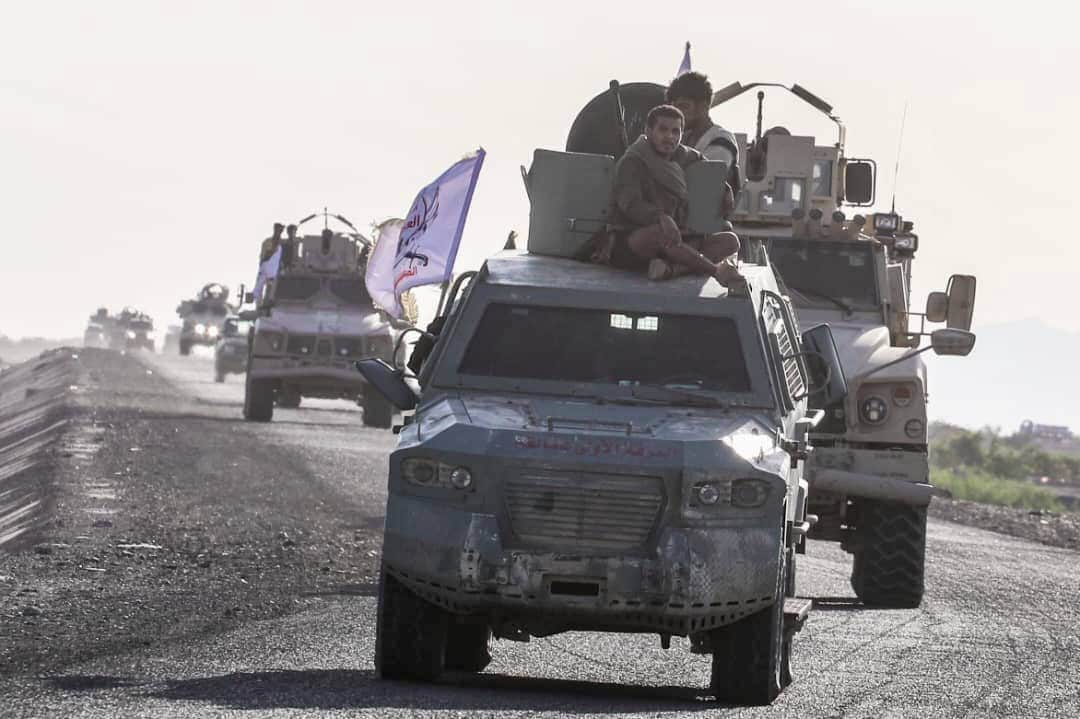
Reinforcements deployed by the Southern Giants Brigades toward Al-Madariba District in Lahj Governorate, October 12, 2026. (Photo: Southern Giants Brigades’ X account)
Last updated on: 19-10-2026 at 7 PM Aden Time

Zeina Al-Ghallabi (South24 Center)
Between early September and October 2026, Yemen witnessed extensive developments on the ground, including military escalation, direct clashes across multiple domestic fronts, and political tensions that expanded beyond Yemen into a broader regional arena. This unfolded amid continued Houthi attacks on civilian and economic facilities inside Saudi Arabia and persistent threats to commercial shipping in the Red Sea and Bab Al-Mandeb.
Houthis’ decision to break the military stalemate on domestic fronts and expand the scope of intense military attacks had far-reaching consequences, leading to major shifts in territorial control along the western coast. Signs of escalation had emerged earlier, most notably when the Houthis targeted Al-Mokha Port with three ballistic missiles, while a fourth missile landed in the city of Al-Khawkha on August 26, 2026. This appeared to serve as an early warning that the defensive readiness of government-aligned forces controlling the western coast needed to be reassessed.
On September 9 and 10, clashes intensified around Al-Mokha, ending with the Houthis taking control of the city and the defending military formations withdrawing, according to the United Nations. This coincided with waves of displacement from the combat zones toward relatively safer areas in Aden and Lahj, amid deteriorating humanitarian conditions. While explanations attributed to the leadership of the National Resistance, affiliated with Brigadier General Tariq Saleh, cited the intensity of the attacks, human casualties, and the risk of encirclement, the immediate military causes of the withdrawal, the nature of the involvement of different military formations, and the responsibilities of field commanders require further official documentation or an independent investigation.
In the following days, Houthis continued advancing toward the Bab Al-Mandeb Strait, amid reports that they had taken control of several islands in the southern Red Sea. On September 15, the United Nations informed the Security Council that the Yemeni government had launched a counteroffensive following the Houthi advance, while clashes continued across multiple domestic fronts.
Several drones also targeted the East-West oil pipeline in the areas between Riyadh and Medina on the morning of September 10, according to a statement issued by the Saudi Ministry of Energy on September 11. The United Nations later indicated that the drones had been launched from an area inside Iraq. On September 14, the Houthis announced that they had targeted King Khalid Air Base in Khamis Mushait, describing the operation as a response to what they claimed were 300 Saudi airstrikes on Yemeni territory.
During the second half of September, clashes continued across dispersed fronts, keeping the escalation along the western coast closely linked to fighting elsewhere in Yemen. On September 28, the Yemeni Ministry of Defense announced targeting operations along the western coast and in Haradh, Al-Tuwal, Marib, and Taiz. Meanwhile, between September 28 and 29, the Southern Giants Brigades announced that they had targeted Houthi vehicles, supplies, and gatherings on the Kahboub front, adjacent to Bab Al-Mandeb.
The Expanding Role of the Southern Giants Brigades
The escalation entered a new phase in early October, coinciding with mounting pressure on the city of Taiz. On October 4, the Houthis cut the last main road linking the city to the governorates of South Yemen, further complicating the movement of residents and supplies. This development added to the importance of the governorate’s front lines, as the pressure on Taiz coincided with preparations for a counteroffensive in the areas surrounding Bab Al-Mandeb. On October 5, a military operation dubbed “Fajr Al-Yemen” (Dawn of Yemen) was announced by the government. On the ground, the Southern Giants Brigades and Nation’s Shield Forces appeared in the assault on Houthi positions in Dhubab District and the surrounding areas of Bab Al-Mandeb. According to a statement by the Southern Giants Brigades, the announced results included taking control of Dhubab Airport, cutting the main road between Al-Mokha and Bab Al-Mandeb, and besieging Houthi positions. If these gains are consolidated on the ground, they would give the attacking forces greater capacity to disrupt overland links between Houthi positions along the southern coastal sector.
In the following days, the ground offensive was accompanied by an intensification of Saudi air operations. On October 9, Riyadh announced a large-scale operation that it said had destroyed 136 military targets in Houthi-controlled areas. On October 10, the Southern Giants Brigades and Nation’s Shield Forces continued advancing in Bab Al-Mandeb and Dhubab, securing the Kahboub Mountains with Saudi air support. On the same day, the Houthis escalated their attacks in a move that raised the cost of the war and disrupted civilian movement in Saudi Arabia. The General Authority of Civil Aviation announced that 12 people had been killed, and 309 others injured in a Houthi missile strike on King Khalid International Airport in Riyadh, forcing a temporary suspension of airport operations. On October 11, Saudi authorities also announced that King Fahd International Airport in Dammam had been targeted. These developments coincided with a joint statement by Saudi Arabia, Egypt, Pakistan, and Türkiye condemning the Houthi attacks and calling for their immediate and unconditional cessation. The statement reflected broader diplomatic coordination in support of Riyadh but did not in itself establish any arrangements for new military participation by the signatory countries.
The Southern Giants Brigades played a key role in regaining the initiative on the ground along the Bab Al-Mandeb front, based on the developments reported in the field. Their contribution lay in their ability to translate military pressure into territorial advances, forcing the Houthis, after a period of expansion, to focus on defending their positions and lines of communication. Their impact therefore went beyond regaining territory to shifting the course of the battle, restoring confidence in the possibility of halting the Houthi advance and forcing a retreat.
The significance of this role stems from Bab Al-Mandeb’s connection to the security of South Yemen, its western coast, and the approaches to Lahj and Aden. The presence of a hostile force capable of consolidating its positions in this area would place sustained pressure on the southern security environment, making its protection a direct interest. The Southern Giants Brigades’ involvement can therefore be understood as an effort to push the threat away from southern areas and strengthen South Yemen’s ability to influence security arrangements concerning the strait and the coast.
Southern Forces: Beyond the Western Coast
The central paradox of southern military formations playing a pivotal role in the current balance of the battle is that this success could open the door to expanding their missions beyond South Yemen’s immediate interests. Every advance could generate demands to continue fighting toward more distant areas, gradually shifting the forces from securing a vital area to shouldering the burden of an extended ground campaign. The danger, then, lies in the widening gap between the objective for which the forces entered the battle and the commitments imposed on them as a result of their success.
The potential attrition of southern forces could include casualties among rank-and-file personnel and commanders, as well as a gradual erosion of operational readiness. However, it is also likely to extend to a reduced capacity to defend South Yemen itself. Keeping the most experienced units on distant fronts for extended periods limits their flexibility in responding to other threats and increases the burden on southern forces holding their positions, which could bear the cost of fighting alone if the Houthis launch a surprise attack on their positions. In addition, controlling further territory creates responsibilities related to security, the population, and public services. These could become long-term commitments whose costs do not end when direct fighting stops.
Politically, the imbalance between the scale of southern sacrifices and the extent of southern participation in decision-making is the most pressing question when the battle shifts from the battlefield to a political settlement process. If southern forces bear the greatest share of the ground fighting without a clear role in defining the campaign’s objectives, limits, and post-conflict arrangements, their military effectiveness could become a resource from which other parties benefit, while the human and social costs remain with South Yemen. The value of these gains therefore depends on the southern leadership’s ability to translate them into genuine participation in decision-making and guarantees for South Yemen’s security, while avoiding the assumption that battlefield victories automatically yield political gains.
In light of this, any expansion of participation should be assessed according to its direct relevance to South Yemen’s security, the clarity of its objectives and end point, the proportionality of its costs to its benefits, and the fairness of burden-sharing among partners. It also requires clarity over which authority will administer areas after they are retaken, so that combat forces do not become a permanent deployment force drained by open-ended missions. The ability to advance must be matched by the political capacity to define the limits of commitment.
The broader problem in the Yemen war, from the last UN-sponsored truce in 2022 through the latest escalation, remains the lack of clarity in the relationship between military and political objectives. Protecting Saudi Arabia’s borders, securing Bab Al-Mandeb, retaking Yemeni territory, and ending Houthi rule are objectives with different requirements and costs. If their priorities and limits are not clearly defined, the campaign could gradually expand, turning localized gains into open-ended commitments.
Aden: A Tool for Military and Political Disruption
The strategic significance of targeting Aden and adding it to the Houthis’ list of targets in the current conflict lies in its predictable role as an escalation step. Aden is the center of gravity for the internationally recognized government and southern forces. The ballistic missile attack on Maashiq Palace, the seat of government, on October 15, 2026, was part of the Houthi group’s efforts to disrupt the security situation, including in Marib Governorate. Launching such attacks at this stage of the Houthi Saudi escalation is intended to impose domestic burdens on areas under the control of the internationally recognized government at various levels, both military and economic. The Houthis also seek to exploit the resulting public uncertainty about the ability of both local authorities and Saudi Arabia to manage the battle within its limited scope along the western coast. Their aim is to turn it into an open conflict across government-controlled areas that have remained relatively secure, including the capital, Aden.
Exaggerating the likelihood of a Houthi advance toward Aden could create confusion and political pressure, limiting the ability of southern forces to consolidate their coastal gains and focus their efforts there. However, this does not mean that Houthi signals should be ignored. The group is testing opportunities to expand southward through continued clashes on the Al-Dhabab, Al-Aqroudh and Al-Shaqb fronts in Taiz Governorate, as well as fighting on the Al-Madariba front in Lahj Governorate on October 12. Alert levels remain high, with forces maintaining their positions and providing support in Karsh and Al-Subaiha.
The appearance of Aidarous Al-Zubaidi, president of the Southern Transitional Council, at this particular moment also carries significance beyond the commemorative occasion it ostensibly marked. It directly helps organize the political and social response to the escalation, linking mobilization rhetoric against the Houthis to the defense of South Yemen and the continuation of its political project. It also presents military participation as directly serving a defined southern interest. From a practical perspective, Al-Zubaidi’s appearance could have a positive impact on the fronts by boosting morale and reinforcing the sense that political leadership stands behind the sacrifices being made. However, while outside government, he cannot single handedly bear the burden of potential fighting or resolve disparities in coordination among southern formations. Nor does his appearance conclusively establish that new understandings have been reached between Abu Dhabi and Riyadh, or that local and regional partners are willing to accept his demands.
Nevertheless, southerners can build on the positions Al-Zubaidi outlined in his speech and agree on shared priorities that protect the southern internal front without eliminating political competition.
Recommendations for Southern Decision Makers
• Define the political and military objectives and limits of participation, with each participating southern party assuming full responsibility for any expansion of its commitments.
• Develop a unified southern position on any potential Saudi Houthi de-escalation and identify the guarantees needed to prevent military pressure from shifting to southern fronts once attacks on Saudi Arabia cease.
• Establish a southern political liaison team comprising representatives from within and outside government. The team should engage with Saudi Arabia, the United Arab Emirates, the United Nations and diplomatic missions, and present a consistent position on protecting South Yemen, securing de-escalation guarantees, and bringing different perspectives closer together.
• Reach a temporary agreement on managing internal southern disagreements, with political forces committing to end accusations of treachery, incitement and mutual recrimination, while preserving the right to criticism and accountability.
• Make the defense of South Yemen and the protection of its population the top priorities in decisions by the leadership of the Southern Giants Brigades and other southern forces. Review the extent of their involvement in the western coast battle if fighting intensifies on southern fronts.
• Seek formal recognition of southern forces as an independent partner in arrangements to protect maritime security in the Bab al-Mandeb Strait and the Gulf of Aden and build balanced regional security partnerships that ensure sustained support for training and equipment, as well as direct representation in coordination mechanisms.