مركز سوث24 للأخبار والدراسات
مركز سوث24 للأخبار والدراسات



Illustrative image circulated online and enhanced using artificial intelligence.
آخر تحديث في: 24-05-2026 الساعة 6 مساءً بتوقيت عدن
South24 Center Editorial | Ahmed Bahakim
While much of the world marked May 8 by celebrating Victory Day or marveling at the accelerating pace of technology, Aden in South Yemen was sinking into total darkness, interrupted only by a faint glimmer of electricity reaching homes for just two hours before vanishing again for another eight. This is not merely a technical fault in a deteriorating system, it is a stark declaration of structural failure and a moral crisis before it is a technical one, pushing the city and its residents to the brink of economic and service-sector “clinical death.”
At 2:30 a.m. on Friday, May 8, 2026, the clock was not merely marking time, it was signaling the depth of the collapse. (1) Eight hours of blackout for every two hours of electricity is a grim equation--meaning Aden’s residents spend 80 percent of their day forcibly disconnected from modern life, trapped in suffocating humidity and relentless heat that turns homes into human ovens and hospitals into waiting rooms of uncertainty.
Aden Between the “Darkness Equation” and the Language of Shocking Numbers
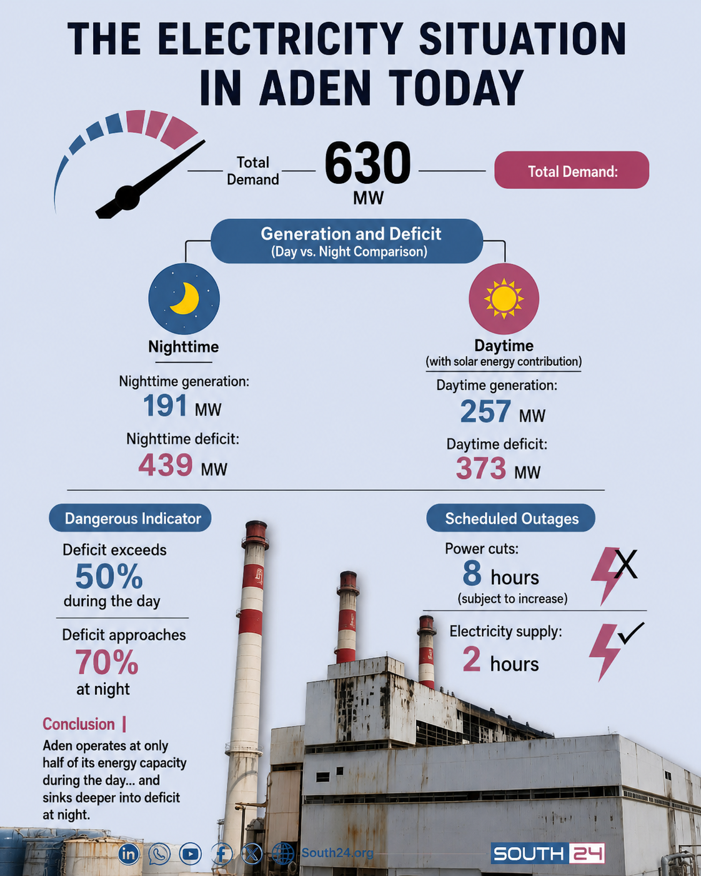
If the crisis is examined beyond emotion, the figures released by the Ministry of Electricity and Energy’s media office paint a bleak picture of the city’s power deficit. (2) This is not a minor shortage, but a widening gap that grows more severe by the day.
Aden’s actual electricity demand during peak summer load currently stands at approximately 630 megawatts, the level required for the city to function normally. Yet the harsh reality is that daytime generation, even at maximum operational capacity and with limited support from solar energy, does not exceed 257 megawatts, leaving a shortfall of 373 megawatts.
The true disaster begins after sunset, when generation falls to just 191 megawatts, pushing the deficit to 439 megawatts. In proportional terms, this represents a shortage equivalent to 70 percent of total demand. This is no longer simply a crisis; it is a state of complete “energy bankruptcy,” where electricity becomes the exception and blackout the norm.
Strategic Projects Trapped in the Maze of Politicization and Fuel Corruption
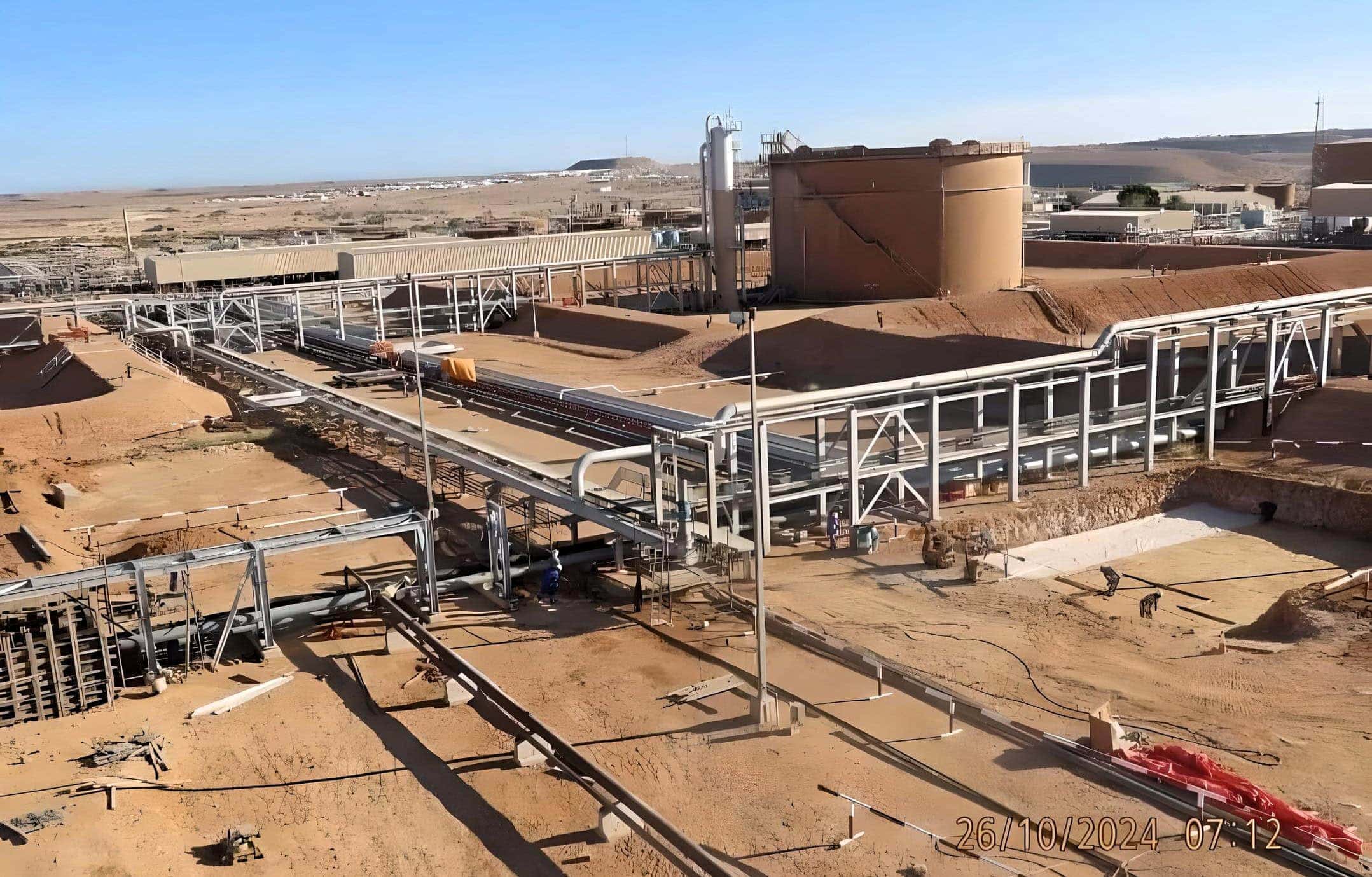
The “PetroMasila Power Plant” was meant to be the cornerstone of Aden’s hopes for overcoming its electricity crisis. Yet a closer look at its operations reveals the scale of the administrative and political dysfunction. The plant, originally designed to supply 264 megawatts in its first phase, with expansion planned later, is currently running at a meager 95 megawatts.
Why this waste? The answer lies in either deliberate or systemic “logistical failure.” (3) The incomplete gas infrastructure connected to the plant has forced reliance on costly crude oil, a fuel supplied irregularly and entangled in political and financial bargaining. Denying the plant its fuel or failing to complete its gas facilities is not merely a technical delay, it is an “economic crime” against the city, effectively wasting up to 135 megawatts of generation capacity that could otherwise be available.
Nor is the PetroMasila Plant the only casualty. The Qatari-funded power station, which was supposed to provide 60 megawatts as a critical relief measure, has also become trapped in bureaucratic deadlock and political conflict. According to the Ministry’s media office, the failure to complete the station’s technical planning deprived the grid of a vital energy source that could have significantly reduced the supply gap.
This raises urgent journalistic questions: Where has the funding gone? Who is obstructing the work of technical teams and contractors? The paralysis of strategic projects capable of adding nearly 400 megawatts to the grid demonstrates that Aden’s crisis is, to a large extent, manufactured rather than merely the consequence of war.
The electricity crisis cannot be separated from Yemen’s broader political conflict, particularly in Aden. Electricity has become both “a bargaining chip” and “a tool of political leverage” among competing factions. Power struggles within state institutions and years of instability have produced near-total paralysis in decision-making.
Investors in the expensive private power sector, which drains public finances, benefit from the continuation of the crisis, while sustainable solutions such as gas-fired plants and renewable energy projects remain shelved indefinitely. The loss of 400 megawatts due to political disputes, as cited in the official report, is compelling evidence that ordinary citizens are paying the price for power struggles within the corridors of power.
From “Dead” Government Promises to a Scorching Summer Inferno
Earlier, Minister of Electricity and Energy Eng. Adnan Al-Kaf proposed an emergency plan that included securing regular fuel supplies, operating power plants at full capacity, and carrying out urgent maintenance work. Yet by May 2026, the plan appears to have been stillborn.
(4) Observers of Yemeni affairs argue that these initiatives lack both genuine “political will” and real financial backing. The ministry finds itself confronting diesel fuel “lobbies” that resist any transition toward gas or lower-cost fuel alternatives, as such a shift would threaten their illicit profits. As a result, the minister’s proposals remain little more than “temporary sedatives” for an increasingly angry public suffering under unbearable heat.
Aden’s electricity crisis has long surpassed the level of inconvenience and entered the realm of humanitarian disaster. In the healthcare sector, hospitals and medical centers face repeated blackouts that endanger patients in intensive care units and compromise heat-sensitive medicines and vaccines.
In the service sector, numerous workshops and small factories have shut down, displacing thousands of workers and worsening unemployment and poverty. Citizens already struggling to secure basic necessities amid the collapse of the national currency now find themselves forced to spend exorbitant amounts on ice, battery repairs, and limited household solar systems incapable of powering even a single air conditioner.
What Aden lacks today is not “plans” or “studies”, but national accountability and political courage. The continuation of eight-hour blackouts for every two hours of electricity constitutes a “declaration of failure” by both the Presidential Leadership Council and the government. No city can grow, no economy can recover, and no social stability can prevail under permanent darkness. (5) The current indicators are deeply alarming, and the cost of delay is no longer sustainable. Unless immediate action is taken to complete the gas facilities at the PetroMasila Plant and secure sustainable fuel supplies free from profiteering and “brokerage networks”, Aden may be heading toward “total collapse”, followed by a public explosion whose consequences cannot be predicted.
Aden is not asking for the impossible. It is demanding its natural right to electricity and to a dignified life worthy of its historical stature. The question remains: will those seated in air-conditioned offices hear the cries emerging from Aden’s darkened homes, or has the “darkness” blinded insight before vision itself?


قبل شهرين

قبل 3 أشهر