مركز سوث24 للأخبار والدراسات
مركز سوث24 للأخبار والدراسات


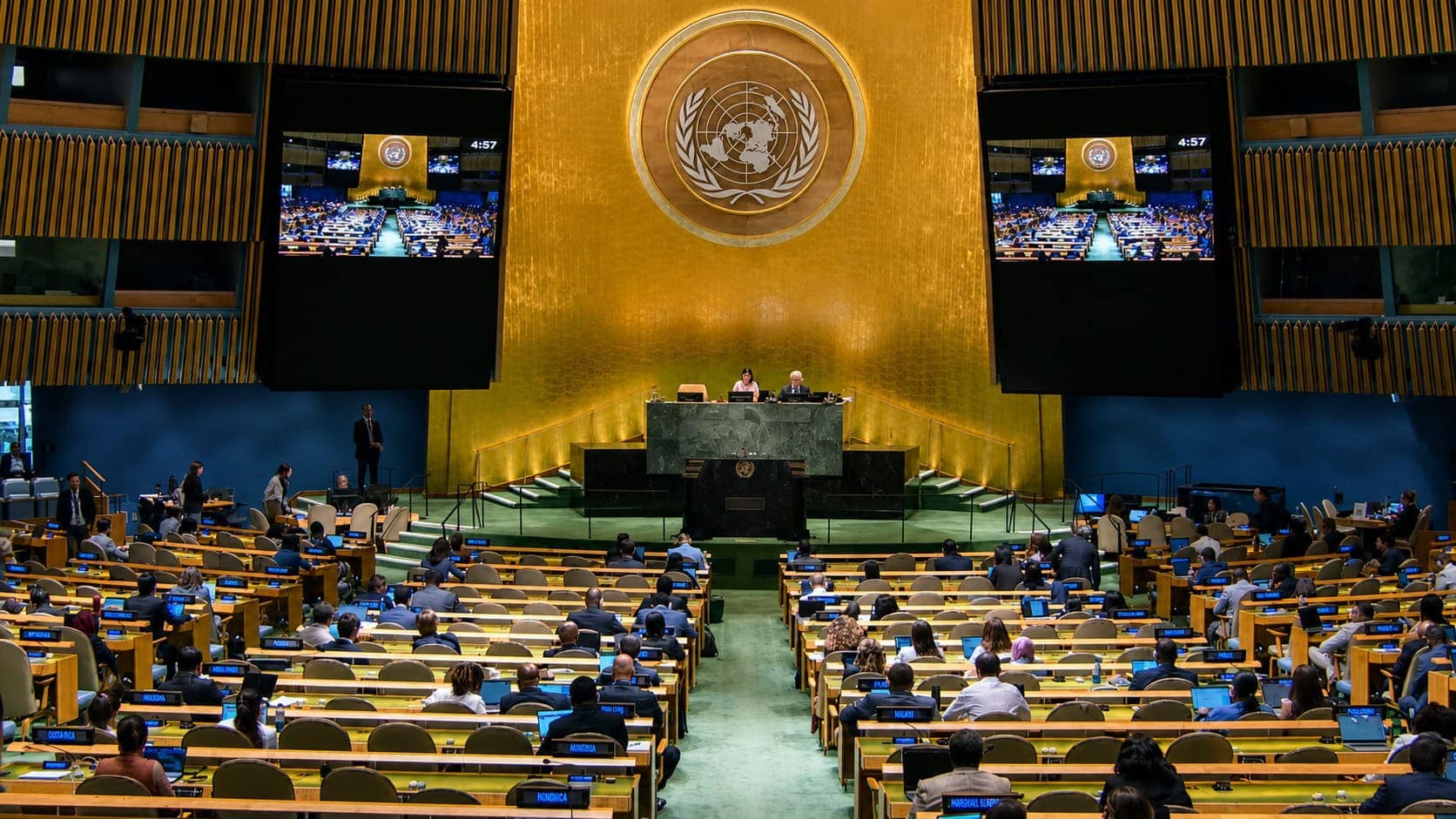
UN General Assembly session adopting resolution A/80/L.65 on states’ climate obligations, May 20, 2026. Yemen was among eight countries voting against it. (UN Web TV / Screenshot by South24 Center)
آخر تحديث في: 07-06-2026 الساعة 4 مساءً بتوقيت عدن
Yemen’s vote against a UN climate resolution exposes a sharp paradox: a country highly vulnerable to climate disasters stood apart from a process meant to strengthen climate justice and accountability.
South24 Center | Zaher bin Al-Sheikh Abubakr
On May 20, 2026, the United Nations General Assembly reopened one of the most sensitive debates in international climate discussions, adopting draft resolution A/80/L.65 on the International Court of Justice’s Advisory Opinion regarding states' obligations in addressing climate change. The resolution, drawn up by Vanuatu - a Pacific island nation on the frontline of the climate crisis, and several other countries, was adopted with broad support from 141 countries, opposed by only eight, with 28 abstentions. Among the eight opposing nations, Yemen's name appears alongside the United States, Saudi Arabia, Russia, Iran, Israel, Belarus, and Liberia, a stance that has prompted considerable scrutiny.
The resolution was far more than a political statement destined for the UN archives. It followed the Advisory Opinion by the International Court of Justice, the UN’s principal judicial body, on July 23, 2025, which ruled that protecting the climate system is no longer a matter of optional diplomacy, but is a legal duty, bound by international treaties, international law, and human rights frameworks. Through adoption of the resolution, the General Assembly welcomed the ICJ Advisory Opinion and called on states to comply with their obligations to protect the climate system and the environment from greenhouse gas emissions caused by human activity. The UN Secretary-General hailed the adoption of the resolution, terming it “a powerful affirmation of international law, climate justice, science & the responsibility of states to protect people from the escalating climate crisis”. The resolution calls for the Secretary General to submit a follow-up report in 2027 on ways to strengthen compliance with the obligations identified in the ICJ Advisory Opinion.
This is where Yemen's paradox begins. Yemen is not an industrialized nation. It bears negligible responsibility for global emissions, yet it stands as one of the countries most vulnerable to the consequences of climate change. Located on the southern end of the Arabian Peninsula in Western Asia, Yemen is increasingly battered by cycles of drought, flooding, and flash floods, in addition to declining water resources, degradation of agricultural land, and disrupted rainfall patterns, at a time when a large portion of its population depends on farming and the already fragile natural resources. Against the backdrop of an ongoing war, deep institutional divisions, and economic collapse, every climate shock carries a heavier cost for Yemen and its people. Every natural disaster pushes vulnerable families further toward poverty, displacement, and livelihood loss.

The UN General Assembly voting board displaying the results on Draft Resolution A/80/L.65 regarding the International Court of Justice’s Advisory Opinion on states' climate obligations, May 20, 2026. Yemen was one of eight countries that voted against the resolution. (UN Web TV / Screenshot by South24 Center)
In theory, in climate justice, Yemen should be among the countries that can find recourse to political and legal pathways, and moral opportunity to strengthen its claims for financing, adaptation, and loss and damage compensation. As a country bearing the cost of a global climate crisis it has barely contributed to, Yemen needs additional tools to defend its affected communities, and it should not be seen as opposing an international process that broadens the conversation around climate accountability. The significance of Yemen’s vote therefore lies not only in its outcome, but in the contradiction it exposes between Yemen's climate reality and its diplomatic position, at a time when international law is playing an increasingly central role in shaping climate governance.
This is not to say that opposing the resolution was necessarily without legal or political reasoning. The United States and Saudi Arabia, two of the most prominent countries that voted against the text, raised concerns about what they viewed as an expansion of legal obligations beyond the agreed framework of the UN Framework Convention on Climate Change and the Paris Agreement. Riyadh cautioned that the resolution could create the impression of new obligations extending beyond what had been collectively agreed upon, while Washington argued that the text granted the non-binding ICJ advisory opinion an outsized legal and operational weight that could interfere with states' sovereign rights to manage their own energy policies.
Yet what may appear understandable within the calculations of major powers or energy-producing nations becomes far more complex when it comes from a country like Yemen -- that is not in a position where it fears to bear significant historical responsibility for emissions, nor does it hold meaningful leverage within global energy markets. It is, above all, a ravaged state, confronting a brutal convergence of war, climate stress, poverty, and the collapse of public services. Its alignment with the opposing bloc raises a fundamental question: was Yemen's position shaped by a clear national reading of the country's climate interests, or did it reflect broader diplomatic and political calculations in which climate considerations were a minor factor?
The question carries added weight because Yemen has been involved in international efforts to channel climate finance toward fragile and conflict-affected states. At COP29, in Baku, Azerbaijan, in November 2024, a group of conflict-affected countries that included Yemen pushed for increased funding to address climate and security crises and called for greater resources to support communities affected by the overlapping of war and natural disasters. Yemen also actively participates in Green Climate Fund programs, related to capacity building, its National Adaptation Plan, its low-emission development strategy, and its Measurement, Reporting, and Verification systems for climate finance and support. These are the actions of a country positioning itself as one in need of climate support. Yet in this vote, Yemen aligned itself politically with the camp resisting efforts to give climate justice greater legal and political force.
This duality lies at the heart of the problem. In financing processes, Yemen presents itself as a fragile state deserving of support, adaptation resources, and loss and damage compensation. Yet, at a significant diplomatic moment, it appeared to resist a path that would give affected countries stronger tools to claim that very redress. Trapped between these two contradictory positions is the Yemeni citizen: the farmer suffering crop failures from disrupted rainfall, families displaced by sudden flash floods, coastal communities facing rising seas, and rural populations confronting water scarcity and shrinking livelihoods.
These communities do not experience climate justice as an abstract legal concept. For them, climate means less water, more expensive food, less fertile land, homes more vulnerable to collapse, and diminished prospects for recovery. While official positions within the UN are dictated in the technical language of sovereignty, obligations, and legal texts, millions of Yemenis are left to battle with the catastrophic consequences of climate change, devoid of any meaningful role in shaping their country's stance. This is where the gap between the state and its victims becomes visible: the state casts the vote, while the victims pay the price.
Climate has evolved into a major geopolitical issue, and is no more a marginal environmental concern. Countries today compete for green finance, adaptation funds, renewable energy programs, loss and damage compensation, and strategic positioning within a global economy that is redefining development through the lens of sustainability. For a severely distressed country like Yemen, the absence of a clear strategy in this space means not only a missed rhetorical opportunity at the UN stage, but potentially the loss of future access to climate financing, institutional capacity building, and life-saving protection for its communities most exposed to risk.
The crisis here is not about a single vote. It is about the absence of a coherent national climate policy capable of distinguishing between short-term political calculations and long-term development interests. Yemen needs an approach that moves beyond seasonal crisis response, and treats climate as a determining factor in food and water security, in social stability, and economic reconstruction. It also needs to involve experts, researchers, local authorities, and the affected communities into the shaping of its international positions, so that climate policy does not remain the exclusive domain of narrow diplomatic assessments, that are fundamentally disconnected with the realities people face on the ground.
Yemen cannot ask the world to finance adaptation, loss and damage, while appearing hesitant or opposed to processes that strengthen the legal and political recognition of states' responsibilities to protect the climate. Nor can it continue to present itself as a fragile and affected country without developing a clear voice that defends the rights of climate disaster victims to environmental justice. This is not a luxury of rights discourse, nor an additional item on a development checklist. It is part of the daily struggle of Yemenis for survival.
The most defining question remains: who will champion the victims of climate disasters in Yemen if the state does not do so in international forums? Climate justice does not belong only to small island nations or large developing economies. It also belongs to a country like Yemen, which is paying the price of a crisis it did not create, while being forced to bear its consequences with some of the weakest institutional and economic capacities in the world. Without a cohesive national climate policy, Yemen will continue to be listed as a vulnerable state while remaining sadly absent or confused in the moments that matter the most for defending its rights. Consequently, the suffering endured by its people will remain real, yet will remain underrepresented in the global decisions that shape their future.



قبل شهرين

قبل 3 أشهر