مركز سوث24 للأخبار والدراسات
مركز سوث24 للأخبار والدراسات


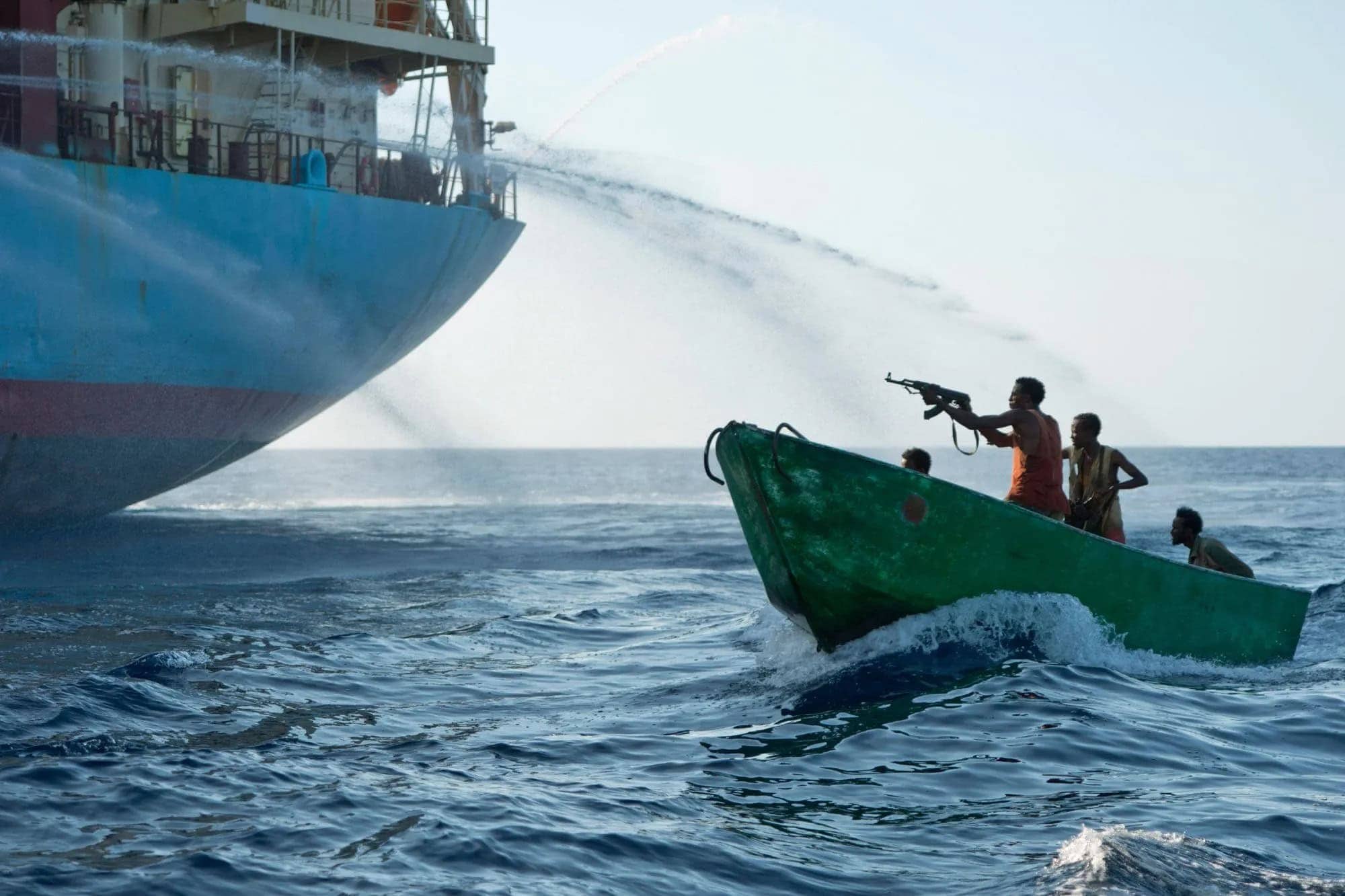
Illustrative image of African pirates, from the film Captain Phillips (film-tv-video.de)
آخر تحديث في: 14-06-2026 الساعة 5 مساءً بتوقيت عدن
Mohammad Fawzi (South24 Center)
Recent months have witnessed a resurgence of piracy incidents off the coast of Somalia that cannot be viewed in isolation from the broader regional security vacuum created by the U.S.-Israeli-Iranian conflict, the Houthi attacks on international shipping in the Red Sea and Gulf of Aden, and also coincides with the growing collaboration between the Shia-led Houthi movement and the Sunni-extremist Al-Shabaab group in Somalia.
The resurgence of maritime piracy off Somalia's coast is an early warning that one of the most serious threats to global trade over the past two decades is back. It reflects a dangerous shift in the security landscape across the Red Sea, the Gulf of Aden, and the Horn of Africa.
I. The Broader Context Behind the Return of Piracy
The return of Somali maritime piracy is no longer an isolated security development or a localized criminal phenomenon. It is a direct reflection of the shifting geopolitical and security landscape affecting the Red Sea, the Gulf of Aden, and the Horn of Africa as a whole.
After years of relative quiet, largely due to sustained international naval patrols and enhanced onboard security for commercial vessels, piracy has again surged at a particularly volatile moment -– coinciding with unprecedented disruptions in the region's maritime security environment. This revival can be understood through three interconnected factors.
1. The Erosion of International Anti-Piracy Deterrence
The resurgence of Somali piracy stems from the gradual weakening of the international deterrence framework that successfully suppressed the threat during its peak between 2008 and 2012.
At the height of the crisis, global powers established a highly-effective, multi-layered security architecture that eradicated piracy through measures, including extensive naval deployments, heavy patrolling throughout the Gulf of Aden and the Indian Ocean, stringent security measures onboard commercial vessels like armed guards, and enhanced real-time intelligence sharing among major naval powers. These efforts led to a dramatic decline in piracy incidents, and fostered the perception that the threat had been brought under control.
In recent years, however, this international military shield has steadily eroded as global powers have redirected their warships and resources toward more pressing crises, including the war in Ukraine, the South China Sea tensions, and, more recently the Houthi attacks on commercial shipping in the Red Sea, that left the Somali basin heavily un-patrolled.
This shift of international focus has led to security gaps across parts of the Horn of Africa and the western Indian Ocean. Piracy networks have been quick to exploit these opportunities, rebuilding operational capabilities that had lain dormant for years. International maritime security assessments had repeatedly warned that declining international vigilance could reactivate the Somali piracy networks, many of which retain their experienced personnel and core logistical capabilities despite years of reduced activity.
2. The Continued Fragility of the Somali State
One of the most significant factors behind the return of piracy is the persistent fragility of the Somali state. Piracy has never been solely a maritime problem. It is a direct consequence of weak governance, fragile institutions, and the state's inability to exercise control over its territory and territorial waters. Although Somalia has made notable progress compared to the period of state collapse, the Federal Government of Somalia faces profound challenges, including limited security capabilities, divisions between the central government and federal member states, the influence of Al-Shabaab over vast stretches of central and southern Somalia’s coast, and lacking resources and personnel to police its massive 3,300 kilometers of coastline, the longest in Africa.
Consequently, Somalia’s capacity to monitor its waters or dismantle criminal networks has been severely constrained, creating ideal conditions for pirate groups to reorganize and strike.
3. The Economic Calculus of Piracy
Economic incentives play a critical role in explaining the revival of piracy. Over recent years, armed groups and criminal networks in Somalia had come under mounting financial pressure as a result of counter-piracy military operations and tighter global banking controls that choked off traditional funding sources. This pushed some of the actors to seek alternative revenue streams, with return to piracy representing a proven highly profitable criminal model, which has been made more attractive by the maritime chaos across the Red Sea and Gulf of Aden.
The expanding links between Al-Shabaab and trans-Red Sea smuggling networks, including those allegedly connected to the Houthis in Yemen, has accelerated the revival of Somali piracy. Reports by United Nations Panel of Experts on Yemen and U.S. intelligence assessments have confirmed growing channels between the Houthis and Al-Shabaab for the transfer of weapons and logistical supplies across the Gulf of Aden.
Through these illicit supply channels, Al-Shabaab has reportedly gained access to increasing supply of sophisticated weapons and ammunition, while other actors like the pirates have benefited from the safe logistical infrastructure the group controls in large parts of Somalia's coastal regions. The convergence of illicit financing, smuggling of sophisticated weapons, and the lack of maritime control has created the ultimate environment for a broader resurgence of piracy across the region.
II. The Houthi Connection to the Resurgence of Maritime Piracy
Any assessment of the return of Somali piracy must consider the role of the Houthis in Yemen whose actions have completely reshaped the regional maritime security dynamics. Several developments point to a growing connection between the two phenomena.
1. Expanding Links Between the Houthis and Al-Shabaab
Despite their ideological differences, recent years have witnessed growing transactional cooperation between Yemen's Houthi movement and Somalia's Al-Shabaab.
In June 2024, U.S. intelligence officials disclosed that they had intercepted direct communications and discussions between the Houthis and Al-Shabaab regarding potential transfer of weapons and military equipment. According to those assessments, the cooperation extended beyond smuggling of conventional arms to include more advanced military technology, such as unmanned aerial systems (drones), missile capabilities, and how to manufacture sophisticated improvised explosive devices (IEDs), the Houthis have developed over recent years.
The relationship between the two extremist groups is driven by a convergence of interests rather than ideological alignment. The Houthis view the alliance as a means to expand their operational reach beyond Yemen and exert pressure on regional and international adversaries while destabilizing security in the Red Sea. For the Al-Shabaab the collaboration means new sources of financing and access to advanced Houthi military tech that strengthens its combat against the Somali government and international anti-terror forces. Against this backdrop, maritime piracy serves as the one practical area of cooperation between the two organizations.
2. The Impact of Houthi Attacks on Red Sea Security
The profound transformation of the security environment in the Red Sea and Gulf of Aden since late 2023 has been a primary driver behind the resurgence of Somali piracy.
Houthi attacks against commercial shipping have completely altered the region's threat landscape. For over a decade, counter-piracy operations were the primary focus of international naval deployments in the area. Today, that focus has shifted to defending against missile attacks, drone strikes, and maritime assaults targeting vessels in the Red Sea and Bab al-Mandab Strait.
As international naval forces redirected resources toward countering the Houthi threat, with Western warships pinned down inside the Bab al-Mandeb, substantial intelligence and operational assets were reassigned away from counter-piracy missions. This gave Somali piracy syndicates the freedom to regroup, rebuild operational capacity, and resume their piracy after years.
3. The Growing Convergence of Conflict Economies Across the Red Sea
The growth of cross-border smuggling networks linking Yemen's coastline with Somalia's shores across the Gulf of Aden, facilitate the trafficking of weapons, ammunition, personnel, and illicit goods, according to reports.
Evidence has emerged suggesting contacts between Houthi operatives and networks operating inside Somalia, including actors linked to Al-Shabaab. Such developments point to an increasing convergence between the conflict economies on both sides of the Red Sea, with logistical exchanges, overlapping illicit financing, shared intelligence and operational services flowing among a diverse range of state and non-state actors, further complicating the picture of the regional security.
4. Converging Strategic Effects
While the Houthis frame their attacks as part of a broader regional political and military struggle, Somali piracy is primarily motivated by financial gain through ransom, extortion, and criminal profiteering. Yet both produce similar strategic damage, creating a massive security challenge across the Red Sea and Gulf of Aden.
In each case, freedom of navigation is threatened through the world’s most critical maritime corridor, leading to rising shipping costs, mounting insurance premiums, and shattering of international confidence in the security of the key maritime corridor. The cumulative impact of Houthi attacks and Somali piracy has created a compound challenge for maritime security across the Red Sea and Gulf of Aden.
This dynamic creates greater incentives and opportunities for collaboration among Houthi-linked actors, piracy networks, and extremist groups in Somalia.
5. Somali Concerns Over Possible Houthi Involvement
Former Somali National Security Adviser Hussein Sheikh Ali has provided key evidence linking the resurgence of piracy to the broader regional dynamics.
In comments to Al Jazeera net, Ali argued that the recent incidents “do not resemble traditional piracy”. Instead, he suggested that high-level coordination exists between actors on both sides of the Bab al-Mandab Strait. His suggestion that the current wave of attacks likely transcends conventional criminal activity, exposing a much more complex network of cooperation, is a potent warning, given his former role overseeing Somalia's national security architecture.
These assessments underscore a growing recognition that the maritime space stretching from the Gulf of Aden to the Arabian Sea can no longer be viewed as a collection of separate security theaters. Instead, it functions as an interconnected environment where armed groups, smuggling networks, and non-state actors exploit shared vulnerabilities to pursue overlapping interests.
In conclusion, the resurgence of Somali piracy should not be viewed merely as the return of a once-contained criminal phenomenon, but reflects a fundamental transformation of the maritime threat environment spanning the Red Sea, the Gulf of Aden, and the western Indian Ocean.
This evolution is being driven by a combination of factors: the persistent fragility of the Somali state, shifting global security priorities, and the rise of new forms of asymmetric warfare in the region. The return of piracy also coincides with a decline in traditional international deterrence, with the security vacuum allowing criminal and militant networks to quickly re-establish themselves.
Perhaps most concerning is how these developments reveal the broader deterioration of regional maritime security. Across both shores of the Bab al-Mandab, organized crime, armed conflict, and transnational smuggling networks are increasingly merging, blurring the lines that once separated criminal activity and political violence.
The consequences extend far beyond isolated hijackings or ransom demands. A sustained resurgence of piracy is sure to drive up shipping and insurance costs, accelerate the militarization of key maritime corridors, and reshape the strategic alignment of major international powers along this vital trade route. For governments, navies, and the shipping industry, the window for effective intervention is rapidly narrowing.



قبل شهرين

قبل 3 أشهر