مركز سوث24 للأخبار والدراسات
مركز سوث24 للأخبار والدراسات


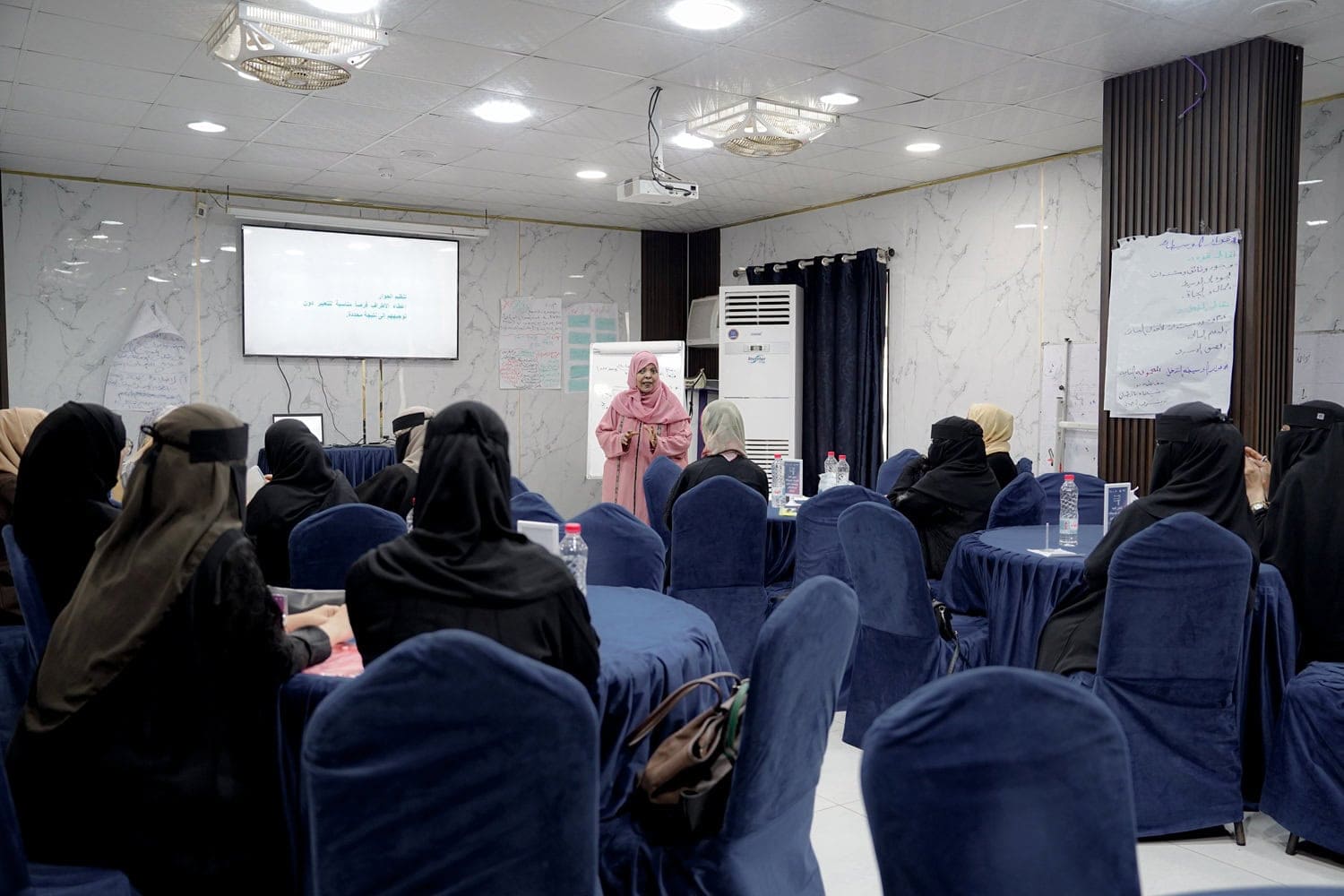
Yemeni women lawyers participate in a South24 Center training workshop on community mediation and local governance in Aden, South Yemen, October 12–14, 2026. (South24 Center)
آخر تحديث في: 26-10-2026 الساعة 5 صباحاً بتوقيت عدن
Latifa Al-Dhufairi (South24 Center)
Caught between their ambition to defend rights and the difficulties of practicing law, Yemeni women lawyers face challenges ranging from limited training opportunities and the financial burden of training to prejudices and judicial obstacles. These difficulties unfold amid a war that has continued for more than a decade, weakening justice institutions and making legal work increasingly complex.
Accounts from seven women lawyers from different governorates, whose professional experience ranges from two to twenty years, reveal varied experiences. Some have overcome societal perceptions and established their presence in courtrooms, while others continue to face difficulties in obtaining qualifications and practicing law. One was forced to leave the profession because of the consequences of the war and the deterioration of the judicial environment.
Despite these challenges, women lawyers play a role in providing legal assistance and defending the rights of litigants, particularly women and the most vulnerable groups. Drawing on firsthand accounts, contributions from judicial and human rights professionals, and UN data, this South24 Center report examines the situation of women lawyers in Yemen, from barriers to entering the profession and challenges inside courtrooms to the impact of war on their ability to continue working and contribute to improving access to justice.
From Studying Law to Practicing as a Lawyer
Lawyer Widad Ahmed’s desire to study law grew out of the violations she witnessed during her childhood in Damt District, Al-Dhalea Governorate. According to her account, women faced denial of education, early marriage, and the deprivation of their inheritance rights, amid social restrictions that limited their ability to claim their rights.
Widad recalls that period, telling South24 Center: “I witnessed firsthand the extent of the violations women faced in the village.” She says what she saw prompted her, from an early age, to decide to study law and defend women. “I made a promise to myself, saying: ‘I will study and become a lawyer to defend women’s rights ... and stand up for women,’” she adds, despite facing ridicule and mockery over her ambition.
However, entering the legal profession does not end with obtaining a university degree. Law graduates must complete a period of professional training before they can practice independently. Yemen’s Law No. 31 of 1999 Regulating the Legal Profession stipulates a three-year training period. It also allows trainee lawyers to represent clients in courts of first instance on behalf of their supervising lawyers after completing at least six months of training, under their supervisors’ responsibility.
The account of Sara Al-Zahrani, a trainee lawyer in Aden, highlights a gap between professional qualification requirements and opportunities to gain practical experience. According to her account to South24 Center, trainees face a shortage of opportunities for hands-on courtroom advocacy, while most of the tasks assigned to them are administrative. Paid training opportunities are also lacking. She says these difficulties are compounded by traditional social attitudes toward women working in courtrooms.
In Al-Jawf Governorate, trainee lawyer Amira Al-Sawdi describes similar financial burdens. She explains that some trainees work full days and represent their supervising lawyers without receiving payment, while having to cover work-related expenses out of their own pockets. She also tells South24 Center that difficulties traveling between districts, the distance between judicial institutions, and checkpoints add to the burdens trainees face during this stage.
Against this backdrop, data published by the United Nations Development Program in April 2026 indicate that 25 female law students from the universities of Aden and Hadramout were offered practical training opportunities in courts, police stations, and public prosecution offices. Fifteen students were from Aden University and ten from Hadramout University. The program provides an example of efforts to link legal education with practical experience, although its results do not necessarily reflect the overall availability of training opportunities for law graduates across Yemen.
Between Prejudice and the Challenges of Working in Court
The challenges facing Yemeni women lawyers do not end with training and professional qualification. They extend to practicing law in courts and prosecution offices, where experiences vary. Some face doubts about their professional abilities rooted in traditional social attitudes and difficulties dealing with certain judicial personnel, while other accounts point to a gradual improvement in the acceptance of women in the profession.
Lawyer Hanan Al-Kathiri, from the city of Seiyun in Hadramout Governorate, recounts how she faced preconceived judgments about women’s ability to practice law at the start of her career. These judgments, she says, had less to do with her professional competence than with prevailing social perceptions of women’s roles. She told South24 Center that one of her most challenging experiences was entering the courts in Seiyun as the first woman lawyer there, according to her account, in a judicial environment accustomed to the presence of men.
Al-Kathiri explains that her presence initially prompted surprise and astonishment, and even rejection from some court staff. However, these attitudes gradually began to change as other women lawyers entered the field. She notes that women’s presence in courtrooms is now more widely accepted than when she began her career, although some prejudices persist to varying degrees.
In the Socotra Archipelago, lawyer Amira Mahdi describes a different experience. She says she is the only woman lawyer in the archipelago, where there are many male lawyers. She told South24 Center that this situation affects how some judges interact with her. While she receives cooperation and respect from some, she encounters reservations among others about dealing with a woman practicing law, compared with their interactions with her male colleagues.
The challenges are not limited to gender-based prejudice. Lawyer Sumaya Ba'ali, from Hadramout, points to obstacles related to the integrity of judicial procedures. She told South24 Center that some of the most difficult situations she encounters in her work involve practices in which bribes are demanded to move procedures forward. She cited cases in which an employee or police officer refuses to execute a judicial arrest warrant without payment, or a prosecution official manipulates a case file, according to her account.
From Sana’a, lawyer Bunyan Jamal offers a different assessment of the professional challenges. She told South24 Center that she has not faced problems because she is a woman. However, she believes the main problem lies in laws that fail to protect women’s rights, as well as what she describes as the growing tendency for some decisions to be made and judicial interests arranged during qat gatherings. These social settings can be difficult for women to participate in on the same terms as men.
In contrast to these experiences, former prosecutor Ali Al-Arshani, who worked in Aden, offers a positive assessment of women lawyers’ performance. Based on his professional experience, he considers their performance before prosecution offices to be generally good. He told South24 Center that he had not observed significant obstacles preventing women lawyers from carrying out their legal duties, noting that they defend their clients and follow up on cases on an equal footing with their male colleagues.
The War and the Challenges of Remaining in the Profession
Years of war in Yemen have exacerbated the challenges facing legal professionals, amid declining effectiveness of judicial institutions and growing obstacles to litigation procedures and the enforcement of rulings. The consequences of the conflict have extended beyond the difficulties of practicing law to affect some women lawyers’ ability to remain in the profession, at a time when the need for legal defense and assistance continues to grow.
Lawyer Widad Ahmed’s experience illustrates some of these consequences. She was forced to leave the profession in 2019 after trying to continue working for several years following the outbreak of war, only to find herself unable to perform her duties under the prevailing conditions.
“I have left the legal profession for now because of the catastrophic situation in Yemen,” Widad says. “I tried to persevere for several years after the war, but I could not. I reached a point where I felt I was lying to myself and to my clients when I led them to believe that we could restore their rights.”
Her account reflects how the deterioration of the judicial environment affects lawyers’ ability to pursue their clients’ rights. Continuing to practice can become increasingly difficult when legal procedures lose their effectiveness and the ability to enforce rights diminishes, even for lawyers with the necessary qualifications and professional experience.
In addition to these risks, logistical and financial burdens pose further challenges, particularly for women in the early stages of their careers. Trainee lawyer Amira Al-Sawdi notes that the absence of a unified judicial complex, the distances between districts, and checkpoints make it more difficult to pursue legal procedures and travel between the relevant authorities. Some trainees are also forced to cover work-related expenses from their own funds.
These difficulties intersect with findings documented by Human Rights Watch in March 2024 concerning restrictions on women’s movement in various parts of Yemen and their impact on women’s ability to access work and services. Although the nature of these restrictions varies depending on the region and the authorities in control, they highlight some of the broader conditions affecting women’s professional activities during the conflict.
Women Lawyers and Their Role in Improving Access to Justice
Despite professional and judicial challenges, Yemeni women lawyers play a role in providing legal assistance and defending the rights of litigants, particularly women and the most vulnerable groups, amid growing legal needs and a declining ability to afford litigation costs during the years of war.
Valentina Mahdi, head of the Yemen Women’s Union in Aden, emphasizes that women lawyers play a prominent role in personal status cases and issues concerning the rights of women and children, particularly alimony, housing, and child custody. She explains to South24 Center that they seek to reconcile disputing parties and bring their positions closer before resorting to the courts when a settlement proves impossible. She notes that funding shortages, some husbands’ evasion of financial responsibilities, and the failure to provide housing for custodial parents are among the main challenges facing legal aid services and the women who benefit from them.
According to the United Nations Development Program, women lawyers from the Yemen Women’s Union, working alongside community workers and relevant organizations, provided assistance in 450 legal cases between February and July 2024. Women benefited from assistance in 145 of those cases.
According to information provided by the United Nations Population Fund (UNFPA) to South24 Center, the fund supported a total of 56 women lawyers in 2025 and 2026 who provided legal services to survivors of gender-based violence across several Yemeni governorates, including Aden, Taiz, Shabwa, Marib, Al Mahra, Hadramout, Abyan, Lahj, Sana’a, Hodeida, Hajjah, Amran, Dhamar, and Al Mahwit. Services included legal consultations, court representation, awareness-raising about rights, and assistance in obtaining personal identity cards for women and girls who had survived violence.
The fund explained that these services are provided through safe spaces for women and girls and shelters, as well as through direct outreach and referrals from displacement camps and partner organizations, under a case management system. According to the data it provided, 17,621 cases benefited from legal consultations and assistance, including 1,335 cases that received legal representation in court, while 1,041 cases benefited from assistance in obtaining personal identity cards.
Meanwhile, Amin Shamsan, an adviser to the Mayyun Foundation for Human Rights, points to increased demand for legal aid during the war, alongside the absence of a unified national database documenting services provided to women. He told South24 Center that, during the year preceding his statement, the foundation provided 120 legal services to women affected by the war, relying on its own resources and the participation of volunteer women lawyers.
Dr. Abdullah Shaddad, head of the Foundation for the Protection of Law and the Promotion of Social Peace, stressed the importance of women lawyers in facilitating women’s access to the courts. Speaking to South24 Center, he noted that some accept minimal fees for legal aid cases, helping people who cannot afford litigation costs. He believes their presence encourages women and their families to claim their rights and emphasized the importance of professional cooperation between male and female lawyers.
Ultimately, the experiences of Yemeni women lawyers reflect a varied professional reality. While some have succeeded in overcoming obstacles and establishing their presence within judicial institutions, others continue to face difficulties that limit their ability to practice and remain in the profession. As the need for legal assistance grows, strengthening women’s participation in the legal profession will depend on improving training and qualification opportunities, protecting judicial independence and the right to legal defense, and providing a safe professional environment that ensures equal opportunities and enables women lawyers to contribute to improving access to justice.