SOUTH24 CENTER FOR NEWS & STUDIES
SOUTH24 CENTER FOR NEWS & STUDIES


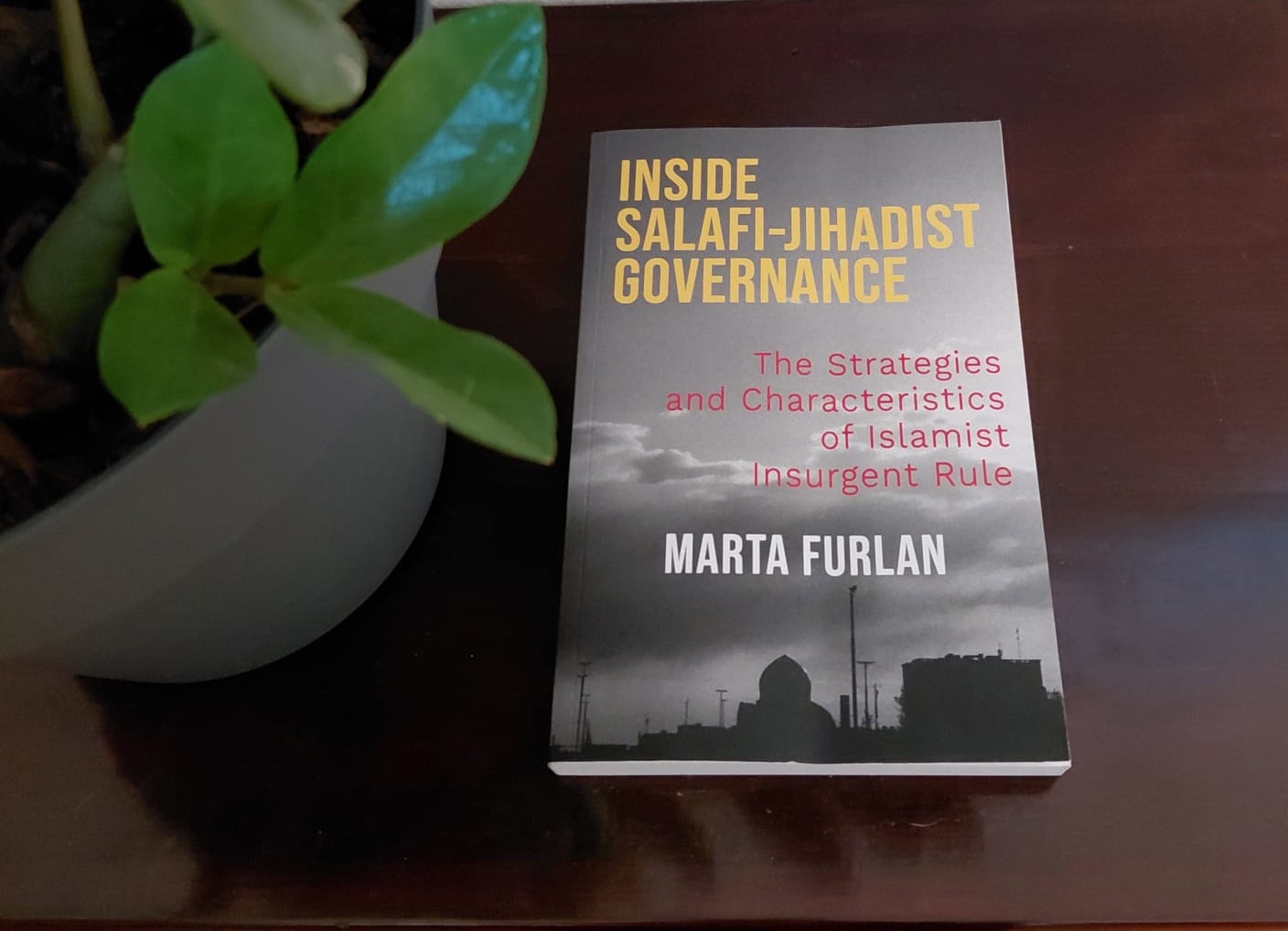
Photo: Inside Salafi-Jihadist Governance book (by Marta Forlani – South24 Center)
10-03-2026 at 12 PM Aden Time

Dr. Marta Furlan (South24 Center)
In the spring of 2020, as the coronavirus pandemic was beginning to spread throughout the Middle East, civilians were provided with guidance on how to behave to prevent the transmission of the virus. Shortly thereafter, schools, markets, and mosques were temporarily closed, quarantine centers were instituted, and cooperation with the World Health Organization for the distribution of vaccines was pursued.
Perhaps surprisingly to many, this effort at prompt and effective governance took place not in some well-functioning nation-state, but in the north-western Syrian governorate of Idlib under the rule of the Salafi-Jihadist group Hayat Tahrir al-Sham (HTS) - which at the time of this writing has become the de facto government of Syria and is now grappling with the management of power at the national level.
Far from being an isolated instance, many other Salafi-Jihadist armed groups have engaged (or have attempted to engage) in similar activities of civilian administration. This has been especially the case after the Arab Spring of 2011, when situations of power vacuum, instability, and disorder in countries such as Libya, Yemen, and Syria opened up new spaces and opportunities for a wide range of armed actors.
Investigating Salafi-Jihadist governance
Considering the extent to which Salafi-Jihadist groups have been increasingly exploiting situations of governance vacuum to create their own alternative systems of rule, it is important to examine Salafi-Jihadist rebel governance, especially its characteristics, its determinants, and its uniqueness. In other words, how do Salafi-Jihadist insurgents govern? Is ideology the factor, or a factor, that shapes Salafi-Jihadist governance? And how does rebel governance vary across Salafi-Jihadist and non-Salafi-Jihadist rebel rulers?
To answer these questions, three groups that are particularly relevant to look at are the Islamic State (IS) in western Iraq and eastern Syria, HTS in north-western Syria, and al-Qaeda in the Arabian Peninsula (AQAP) in southern Yemen. In fact, IS, HTS, and AQAP represent three of the most prominent cases of Salafi-Jihadist insurgent governors registered to date: they have engaged in governance for a significant amount of time, they have intervened in an extensive range of governance activities, and they have governed entire governorates and major cities.
Relying on the textual, audio, and video materials produced and disseminated by the three groups, existing interviews with people who lived under IS, HTS, and AQAP, key informant interviews with journalists, scholars, civil society representatives, humanitarian workers, and human rights activists working in Syria, Iraq and Yemen, and secondary sources such as academic papers and journalistic reports, I make three main arguments on Salafi-Jihadist governance.
How do Salafi-Jihadist insurgents govern?
First, there are important similarities in the approach to governance maintained by different Salafi-Jihadist armed groups. For instance, Salafi-Jihadists display a tendency to adopt highly discriminatory approaches towards civilians. On the one hand, they adopt a discriminatory approach based on religious identity, whereby only Sunni Muslims are considered legitimate members of their desired polity, while Shia Muslims, Christians, Druze and other religious minorities are discriminated against or even persecuted. On the other hand, they adopt a discriminatory approach based on gender, whereby women are subjected to much stricter regulations than men in every aspect of life, such as the capacity to access educational and economic opportunities.
Additionally, Salafi-Jihadists are similar in that they tend to exclude the broad civilian population from participation in governance. Civilians are never included in the elections of their representatives and are hardly ever given an opportunity to voice their preferences and demands. The reins of decision-making are tightly and exclusively in the hands of the Salafi-Jihadist rulers.
At the same time, however, differences between Salafi-Jihadist groups in matters of governance are as evident as they are relevant. For instance, IS preferred to govern mostly in isolation, rather than in cooperation (or partial cooperation) with other actors like HTS and AQAP. IS also employed more extensive, extreme, and publicized forms of coercion than HTS and AQAP, which used financial fines and corporal punishments at the same time that they used written publications, religious symbols, and public events to encourage civilian compliance and obedience. For its part, AQAP differed from IS and HTS in that it maintained pre-existing institutions and practices of governance, such as tribal customary law, to a considerably greater extent.
Following these observations, I argue that a single model of Salafi-Jihadist governance does not exist. Rather, each Salafi-Jihadist group develops its own peculiar model of governance, which might differ (slightly, partially, or even significantly) from the models of governance developed by other like-minded groups.
What is the relationship between ideology and Salafi-Jihadist Governance?
Second, I argue that the patterns of governance adopted by Salafi-Jihadist armed groups are shaped in important ways by ideology. In fact, the ideological imperatives imposed by Salafi-Jihadism are useful to explain some of the behaviors displayed by Salafi-Jihadist rebel rulers, such as the tendency to discriminate towards non-Muslims, non-Sunnis, and women, the rejection of democracy and the denial of broad civilian participation, the use of extensive coercion, including in a widely publicized fashion, the exclusion of other non-Sunni and non-Salafi-Jihadist actors regardless of their capacity and legitimacy, and the preference for extensive socio-political innovations inspired by the Prophetic model.
However, there are limits to the capacity of ideology to explain Salafi-Jihadist governance. Doctrine, for instance, cannot explain the propensity of HTS and AQAP to cooperate with several non-Salafi-Jihadist actors, such as community leaders, as well as the openness of IS to a certain cooperation with the “apostate” Syrian regime. Doctrine is also poorly positioned to explain the tendency of HTS and AQAP to include a civilian élite in governance. Equally, doctrine cannot explain the tendency of AQAP to maintain pre-existing institutions and practices to a quite considerable extent, even when distant from the tenets of Salafi-Jihadism.
Therefore, while ideology is useful to illuminate several of the governance decisions made by Salafi-Jihadist ruling armed groups, a more comprehensive and accurate understanding requires going beyond doctrine. Additionally—and coherently with the previous argument that different Salafi-Jihadist groups can develop somewhat different models of rebel governance—the extent to which ideology shapes Salafi-Jihadist governance is not uniform across cases, but rather varies (and even considerably so) from one group to the other.
How does rebel governance vary across Salafi-Jihadist and non-Salafi-Jihadist groups?
Third, Salafi-Jihadist armed groups may display a series of uniquely peculiar features when compared to the models of governance adopted by non-Salafi-Jihadist rebel rulers worldwide, such as the FARC in Colombia and the LTTE in Sri Lanka. Specifically, the former distinguish themselves for their tendency to discriminate against non-Muslims, non-Sunnis, and women. Regarding the approach to pre-existing structures and practices, IS and HTS also distinguish themselves for their propensity to introduce extensive innovations, whose foundations are to be found in the sources of Islam and the socio-political model of the earliest caliphates. Besides, IS also distinguishes itself for the propensity to exclude most other actors from governance—especially those who do not submit to the Salafi-Jihadist authority—and for its use of extensively and widely publicized coercive practices.
However, while some unique patterns of Salafi-Jihadist governance can be identified, there are also important similarities between Salafi-Jihadist and non-Salafi-Jihadist ruling armed groups in their approach to governance. For instance, the cooperation with other actors and the use of persuasion alongside moderation are patterns that HTS and AQAP have in common with non-Salafi-Jihadist rulers. HTS and AQAP also resemble other non-Salafi-Jihadist groups in their tendency to combine coercion and persuasion to comparable extents.
Therefore, just as Salafi-Jihadist governance is not necessarily uniform across different Salafi-Jihadist groups, so the distinctiveness of Salafi-Jihadist governance is not universal and thus should rather be assessed individually for each Salafi-Jihadist governance experiment. In other words, while Salafi-Jihadist governance may display some unique features, the extent of such uniqueness varies across groups.
Conclusion
In conclusion, I suggest that the term “Salafi-Jihadist governance”—which is widely employed by scholars, policymakers, journalists, and humanitarians—should not be taken to allude to a discrete, universal and unique model of governance. Rather, it should indicate the act of governance by Salafi-Jihadist armed groups, which is a heterogeneous phenomenon whereby Salafi-Jihadist insurgents engage in civilian administration developing possibly different and distinctive patterns of governance that may be driven by the ideological tenets of Salafi-Jihadism, but are not necessarily so.