SOUTH24 CENTER FOR NEWS & STUDIES
SOUTH24 CENTER FOR NEWS & STUDIES


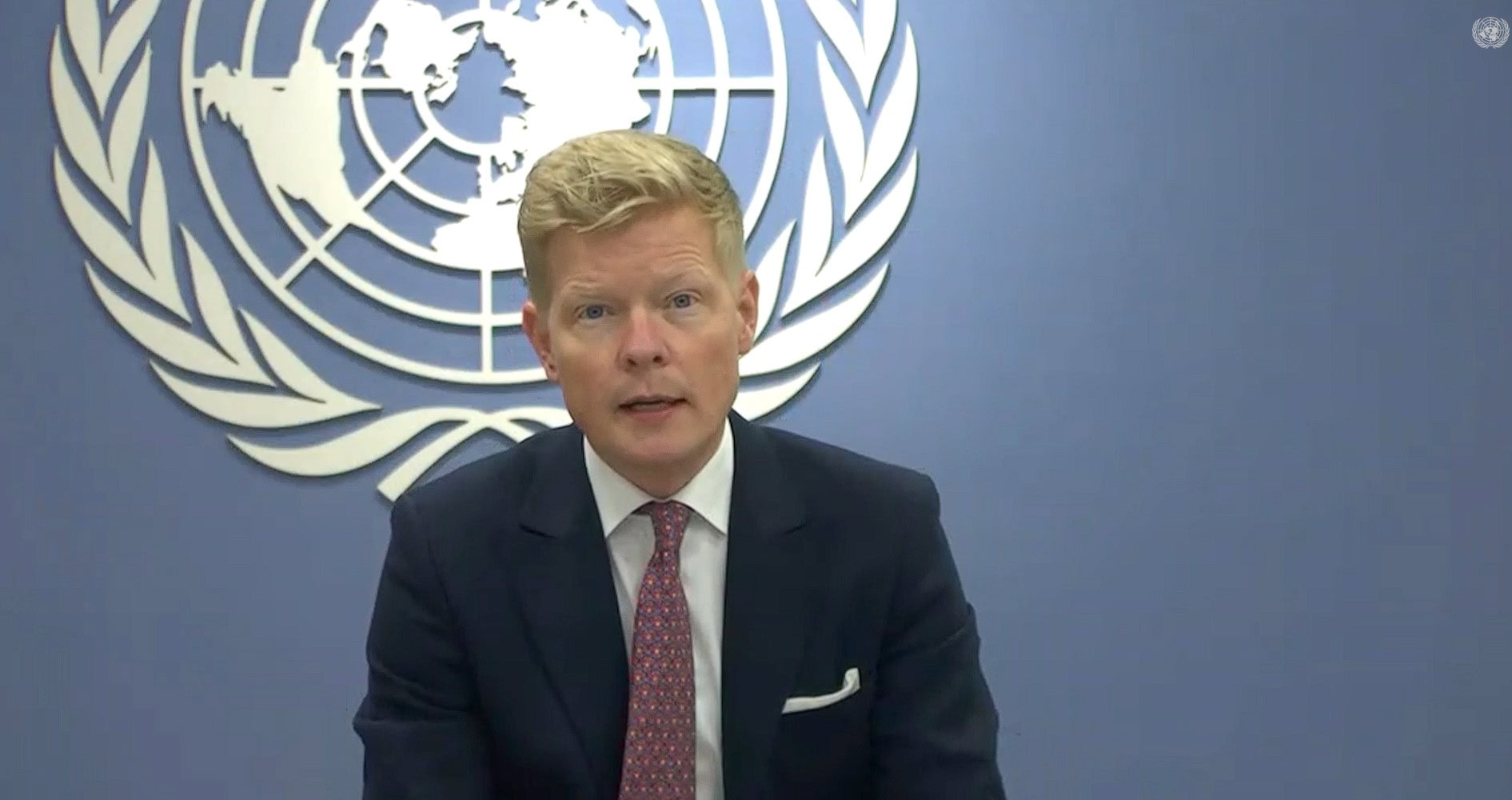
UN Special Envoy for Yemen, Hans Grundberg, during the session (South24 screenshot from the live broadcast)
15-04-2026 at 3 PM Aden Time
Aden (South24 Center)
The UN Special Envoy for Yemen, Hans Grundberg, expressed concern on Tuesday (April 14) over casualties during recent protests in Hadramout Governorate, warning that such developments could undermine the country’s fragile stability.
In his briefing to the Security Council, Grundberg referred to events in the city of Mukalla, where protests resulted in casualties from security gunfire. He welcomed a call by Rashad al-Alimi to open an investigation, stressing the need to ensure accountability and protect civilians.
He emphasized the importance of preserving space for peaceful expression, particularly amid mounting economic pressures and political tensions.
On April 4, two protesters were killed and four others injured when security forces backed by Saudi Arabia dispersed demonstrators supporting the Southern Transitional Council.
Grundberg’s remarks came as part of a comprehensive briefing in which he reviewed political, economic, and humanitarian developments in Yemen amid escalating regional tensions.
In this context, he expressed sympathy for civilian suffering across the region, noting that the ceasefire between the United States and Iran could help ease tensions and lift the "shadow of fear and uncertainty" hanging over the region.
He pointed out that Yemen has not been immune to the "gravitational pull" of the conflict, particularly following attacks launched by Ansar Allah against Israel in late March, warning of the risk of the country being drawn into a broader regional confrontation, although it has so far avoided that outcome.
He called on the group to refrain from further attacks and urged all parties to adhere to de-escalation efforts.
Grundberg noted that over the past two months, he has held intensive consultations with Yemeni and international actors, focusing on safeguarding the peace process and ensuring freedom of navigation in the Red Sea and the Gulf of Aden.
On the economic front, he highlighted his meeting in Aden with the new government led by Prime Minister Shaya Al-Zindani, noting that its priorities include stabilizing the economy, improving electricity supply, and paying public sector salaries.
Read more at: UN Envoy to Yemen Holds Series of Meetings in Aden
He described the approval of the 2026 state budget — the first in seven years — and the conclusion of consultations with the International Monetary Fund as "important milestones," while warning that the poorest remain vulnerable to import disruptions and rising prices. He also criticized what he described as the "weaponization of economic life" and the continued obstruction of oil and gas exports.
On the security front, Grundberg pointed to "worrying indications," including troop movements and potential escalation despite the relative calm maintained since the 2022 truce. He also noted civilian casualties in attacks across several governorates, including Hajjah and Taiz.
He called for respect for international humanitarian law and accountability for violations.
Regarding Hodeidah, he said that the mandate of the United Nations Mission to Support the Hodeidah Agreement ended in late March, while UN efforts continue to support the agreement through communication channels with the parties.
On detainees and prisoners, he noted that negotiations in Amman have lasted ten weeks — the longest round so far — adding that "significant progress" has been made, but further compromises are needed to reach a final agreement.
He renewed his call on the Houthis to "immediately and unconditionally" release all detained UN and NGO staff, describing their detention as a violation of international immunities that undermines the UN’s work.
Grundberg concluded by stressing that an inclusive political process remains the only viable path forward, warning that Yemen’s future should not be "held hostage" to regional turmoil. He urged all parties to invest in a political settlement rather than "betting on the storm" of regional conflicts.
During the session, statements by Security Council members reflected differing international approaches to the Yemen file, alongside a broad consensus on the country’s fragility and the complexity of the crisis.
Colombia’s representative expressed concern over the “complex challenges” facing Yemen, including institutional fragility, noting that recent incidents in southern Yemen are being closely monitored.
Pakistan’s representative said that “competing political agendas are hindering progress toward a comprehensive political process in Yemen,” warning that the presence of multiple actors — particularly in the South — undermines the national framework.
Similarly, China’s representative noted that “parties to the conflict in Yemen do not trust one another,” adding that the suspension of dialogue tracks reflects ongoing political deadlock and the overall fragility of the situation.
Russia’s representative stressed that “any political settlement in Yemen that does not include all parties, including the Houthis, is doomed to fail,” cautioning against attempts to isolate any Yemeni actor or create hostile dynamics that could obstruct peace efforts.
Meanwhile, the United Kingdom’s representative urged Ansar Allah not to draw Yemen into a broader regional conflict, stating that recent attacks are “unacceptable, threaten regional stability, and undermine Yemen’s security.”