SOUTH24 CENTER FOR NEWS & STUDIES
SOUTH24 CENTER FOR NEWS & STUDIES


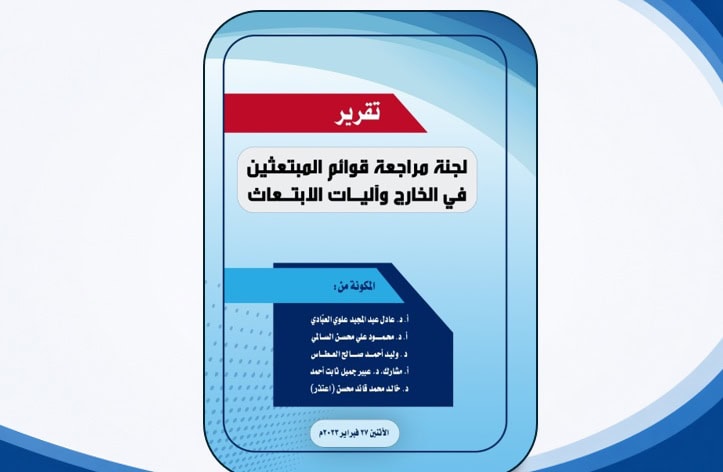
Cover of the report circulated among journalists and activists (South24 design)
Last updated on: 26-07-2026 at 10 PM Aden Time
Aden (South24 Center)
A Yemeni government report has revealed widespread irregularities in the Ministry of Higher Education’s overseas scholarship programme, including political interference, suspected forgery, additions outside approved lists, and the concentration of awards among influential families.
A copy of the report was leaked to the media and circulated by journalists and activists over the past few days. South24 reviewed the document, which said the scholarship system had undermined equal opportunity, wasted public funds and deprived academically qualified students of fair access to study abroad.
The report was prepared by an academic committee appointed under Decision No. 39 of 2022, issued by then-Prime Minister Maeen Abdulmalik. It was submitted to the prime minister on 27 February 2023 after the committee reviewed scholarship lists, student files and ministry records.
According to the report, overseas scholarships administered since the ministry relocated to Aden in 2016 operated without the committees required under Scholarships and Grants Law No. 19 of 2003.
It said financial assistance for students abroad was often allocated through directives, recommendations and personal intervention rather than public competition, academic merit or published criteria.
The directives came from government officials, ministers, governors, members of parliament, ambassadors and figures within the ministry and its scholarship sector.
The report referred to family, political and regional influence, as well as allegations that scholarships and financial assistance were bought and sold through intermediaries.
It documented cases in which students with secondary-school grades ranging from 69% to 74% received scholarships in competitive fields such as medicine, dentistry and petroleum engineering, while applicants with higher grades were excluded.
Some students who had failed competitive examinations later appeared on scholarship lists, including a case involving human medicine at Al-Azhar University in Egypt.
The committee recorded 508 scholarship cases involving siblings from 284 families. Families and sibling groups accounted for about 33% of the recipients reviewed, while some families obtained more than 16 scholarships.
It also found cases in which family names were removed or altered, making links between recipients more difficult to identify. Children and relatives of officials and ministry employees appeared on financial assistance lists.
The report described additions to scholarship lists as one of the main causes of disorder in the programme.
It said 1,565 students were added in 2018 alone, at a cost exceeding $4.35m. A further 174 additions were recorded in the final quarter of 2021, despite official instructions to stop the practice.
Some files lacked formal scholarship decisions, secondary-school certificates or other essential documents. The committee said some applications were processed using photographs sent through messaging platforms.
It also recorded 44 students added during the third and fourth quarters of 2021 despite incomplete documentation.
For Egyptian scholarships in the 2022-2023 academic year, the committee found 28 names outside approved lists, including 21 undergraduate and seven postgraduate students.
It recorded another 15 additions to Hungarian scholarships, comprising eight undergraduate and seven postgraduate students.
The report also said the ministry prevented 53 of 60 selected students from travelling to Sudan, citing conditions in the country, but later added more than 25 other students to sponsorship lists for Sudan.
The committee documented suspected forgery involving a directive attributed to a former vice-president, whose office reportedly denied its authenticity.
A separate case involved more than 80 directives and signatures allegedly forged or falsely attributed to an official in the scholarship sector. The case reached the Public Funds Court in Aden.
The report also found that financial assistance continued to be paid to students originally sponsored in 2010, 2011 and 2012, despite some exceeding legal study periods, completing their studies or failing academically.
It said some recipients continued to receive thousands of dollars through extensions linked to mediation, personal influence or alleged bribery.
The committee questioned public spending on subjects already available at Yemeni universities. It found that about 36% of recipients sponsored through public universities were studying literary and humanities subjects available locally.
Despite being appointed by a prime ministerial decision, the committee said it struggled to obtain key documents from the ministry, including meeting minutes, files containing senior-level directives and recipient lists organised by governorate.
The report recommended broad changes in the leadership of the Ministry of Higher Education and its scholarship sector.
It called for open competition, published criteria, the activation of legally mandated committees, and an end to scholarships awarded through political or personal directives.
It also recommended stopping additions outside approved lists, withdrawing support from students who had exceeded legal study periods, preventing repeated awards to members of the same families, limiting overseas scholarships to rare subjects unavailable in Yemen, and establishing a unified electronic database.
Previous article
Next article