SOUTH24 CENTER FOR NEWS & STUDIES
SOUTH24 CENTER FOR NEWS & STUDIES


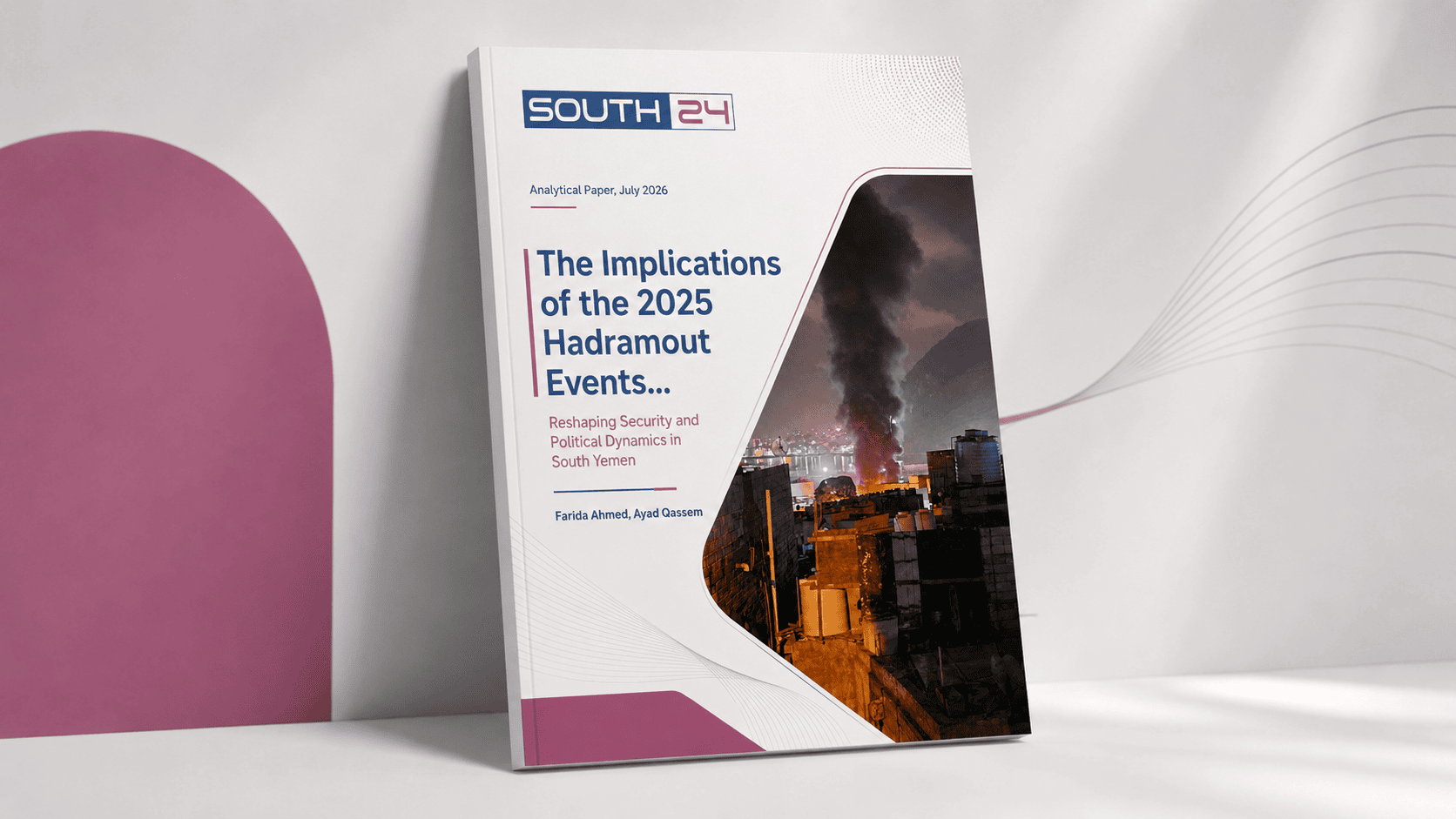
The paper’s cover was designed with the assistance of ai. (South24 Center)
Last updated on: 31-08-2026 at 11 AM Aden Time
South24 Center (Aden)
South24 Center for News and Studies has released the English version of an analytical paper examining how the events in Hadramout in late 2025 reshaped the security and political balance of power in South Yemen and altered the roles of key local and regional actors.
The paper, titled “The Implications of the 2025 Hadramout Events: Reshaping Security and Political Dynamics in South Yemen,” was originally published in Arabic in July 2026 and is authored by Farida Ahmed and Ayad Qassem.
It analyzes the military and political developments that began with the Southern forces’ advance into the Hadramout Wadi and Desert and Al Mahra, followed by Saudi military intervention and the subsequent withdrawal of the forces.
The paper argues that the events went beyond a temporary military confrontation, triggering a broader restructuring of South Yemen’s security architecture, an expansion of Saudi influence, and a decline in the UAE’s direct role. It also examines the political repercussions for the Southern Transitional Council (STC), public reactions to the post-crisis arrangements, and the risks posed by political and security fragmentation.
The study further explores Saudi Arabia’s strategic interests in Hadramout, including the governorate’s geographic position, energy resources, border security, and access to the Arabian Sea, while assessing the impact of changing Saudi-Emirati dynamics on South Yemen’s political future.
It presents three potential scenarios for the next phase: a Saudi-sponsored Southern settlement, continued fragmentation and fragile stability, or renewed Southern political cohesion leading to a more balanced settlement. The paper considers the latter the most viable pathway toward sustainable stability, provided it is accompanied by substantial internal reform and broader Southern representation.
Among its key recommendations, the paper calls on the STC to strengthen internal cohesion, restructure its organizational framework, broaden political representation, develop a clear negotiating vision, improve engagement with local actors in Hadramout and Al Mahra, and work toward building a wider Southern political coalition.
It also urges Saudi Arabia to provide clear political guarantees for any South-South dialogue, maintain engagement with the STC as a major political and social actor, and reconsider the deployment of non-local northern forces in sensitive governorates such as Hadramout and Al Mahra in favor of professional local forces with greater community acceptance.
The paper can be viewed and downloaded below: