SOUTH24 CENTER FOR NEWS & STUDIES
SOUTH24 CENTER FOR NEWS & STUDIES


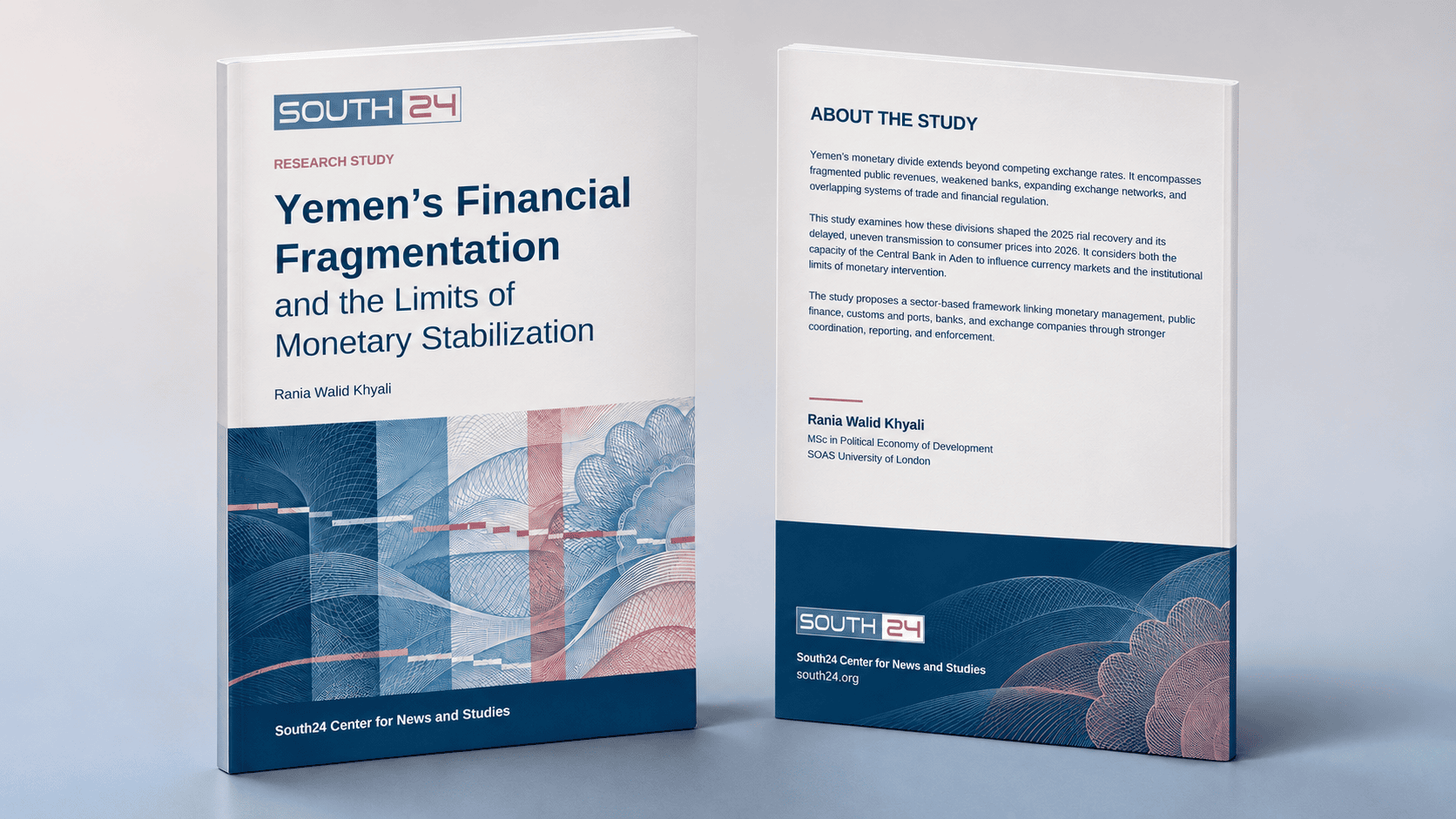
The study’s front and back covers were designed with AI assistance.
12-11-2026 at 4 PM Aden Time
Aden (South24 Center)
Yemen’s central bank can influence currency markets, but sustaining exchange-rate gains and translating them into lasting price relief requires stronger coordination across the country’s fragmented financial and economic institutions, according to a study prepared for South24 Center for News and Studies.
The study, “Yemen’s Financial Fragmentation and the Limits of Monetary Stabilization,” by Rania Walid Khyali, examines how competing monetary authorities, weakened banks, dispersed public revenues, and expanding exchange-company networks have constrained economic stabilization. It traces these developments through the 2025 recovery of the Yemeni rial and subsequent price adjustments into 2026.
Its central finding is that the rial’s appreciation demonstrated the capacity of the Central Bank of Yemen in Aden to influence foreign-exchange markets when regulatory enforcement, import financing, and political support aligned. However, the speed and extent of the benefits reaching consumers depended on institutions and commercial networks beyond the bank’s direct control.
Drawing on institutional reports, economic indicators, and specialist interviews, the study identifies weak coordination between monetary policy, public finances, trade, and financial regulation as a central obstacle to durable stabilization.
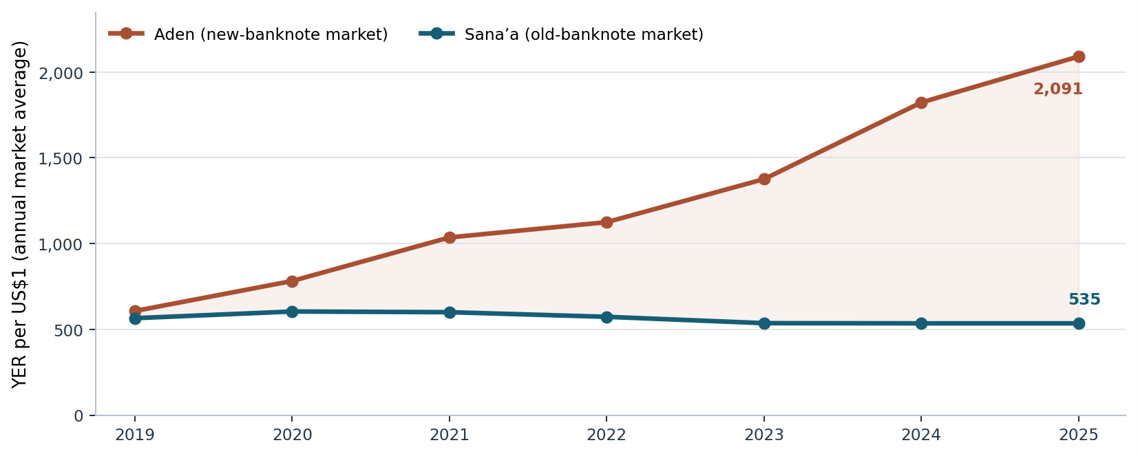
Figure 1A. Annual average exchange rates in Aden and Sana’a, 2019–2025 (YER/US$). Source: Based on World Bank data, Yemen Economic Monitor (Fall 2024), table 1.1 (2019), and Yemen Economic Monitor: Pushing Against the Tide (Spring 2026), table 1.1 (2020–2025).
The July–August 2025 recovery provides the clearest illustration. Citing ACAPS data, the study notes that the monthly average exchange rate in government-controlled areas moved from approximately 2,837 Yemeni rials per US dollar in July to 1,632 in August. The improvement coincided with tighter supervision of exchange companies, measures to regulate import financing, and external financial support.
Consumer prices also fell substantially. According to figures cited in the study, the average minimum food basket cost in government-controlled areas declined from approximately 199,000 rials in July to 129,000 in September. Later assessments recorded further easing of inflation as the effects of the stronger currency gradually reached domestic markets.
Yet the adjustment remained uneven across commodities, locations, and time. Transport costs, competing customs charges, inventories purchased at earlier exchange rates, and uncertainty over the durability of the recovery continued to shape retail prices. Food basket costs began rising again after November, although they remained below their year-earlier level in January 2026.
The study therefore cautions against treating exchange-rate recovery as sufficient evidence of lasting economic stability. Monetary intervention delivered meaningful relief, but sustaining that relief required more consistent market oversight and coordination across the institutions governing prices, revenues, and financial flows.
These constraints developed over years of institutional division. Following the relocation of the central bank’s headquarters to Aden in September 2016, monetary authority became increasingly fragmented. Restrictions imposed by the Sana’a-based authorities on newer banknotes in late 2019, and more strictly enforced in early 2020, deepened the separation between currency markets.
The resulting divergence extended beyond exchange rates. Banks, traders, and households operated across competing rules governing payments, currency circulation, customs, and financial supervision.
Relative exchange-rate stability in Sana’a also carried significant limitations, the study argues. Restrictions on banknotes and transfers, deteriorating older currency, and uneven access to financial services imposed costs that nominal exchange-rate figures alone could not capture.
Meanwhile, declining confidence in formal banks helped exchange companies expand beyond currency conversion and remittances into trade financing and the handling of customer funds. These businesses became increasingly important financial intermediaries, while substantial liquidity continued circulating outside formal banking channels.
For the central bank in Aden, this complicated supervision and made foreign-exchange demand harder to assess. Efforts to regulate institutions operating across competing jurisdictions also encountered political and territorial constraints.
Fiscal weakness reinforced these difficulties. The prolonged suspension of government oil exports following attacks on export facilities in late 2022 reduced both public revenues and foreign-exchange earnings. Customs and port receipts consequently became more important to the government’s remaining revenue base.
However, competing taxation systems, changes in import routes, and incomplete transfers of locally collected revenues to central accounts weakened fiscal coordination. Continued dependence on central-bank financing further linked government budget pressures to monetary instability.
External financial assistance helped ease immediate import-financing and foreign-exchange shortages, but the study finds that such support could not replace a reliable domestic revenue base or effective controls over public funds.
To address these problems, Khyali proposes a sector-based coordination and enforcement framework jointly led by the central bank in Aden and the Ministry of Finance. It would bring together customs authorities, port administrations, relevant ministries, regulated banks, exchange companies, and major import-financing actors.
The proposed framework would begin with practical, measurable tasks: reconciling customs and port receipts with government-bank deposits, identifying public accounts outside approved channels, and checking import-financing allocations against documented transactions.
Access to official financing facilities, licenses, and relevant government contracts would be tied to reporting and compliance requirements, supported by transparent eligibility criteria, appeal procedures, and proportionate penalties.
The study recommends introducing reforms gradually within the internationally recognized government’s effective jurisdiction. Its proposed measure of progress is whether more revenues reach treasury-controlled accounts, financial decisions become more transparent, and documented violations are addressed consistently—steps that could strengthen the central bank’s ability to sustain currency gains and extend their benefits to the wider economy.